
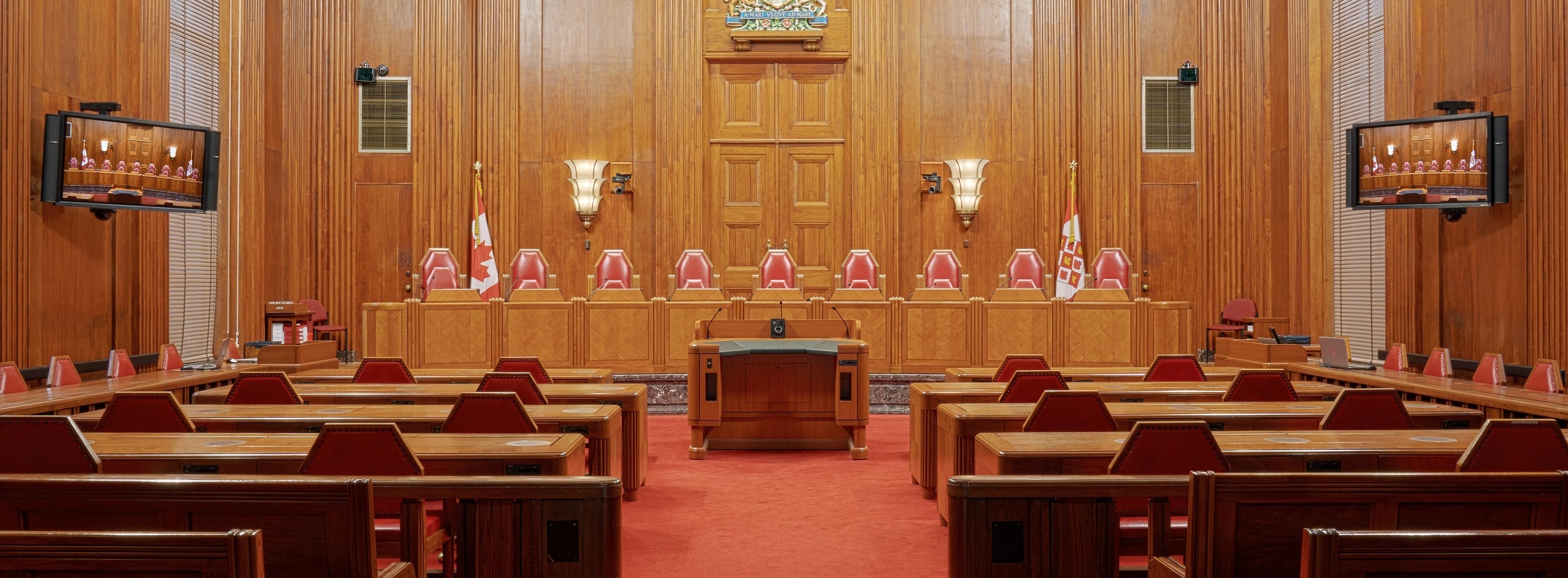
THE MAIN COURTROOM
Welcome to the Supreme Court of Canada, Canada’s highest Court. You are now sitting in the public gallery and are about to watch a case that has worked its way through the lower courts to the Supreme Court of Canada. You will hear oral arguments from the appellant and respondent. Each side has 1 hour to plead before the Court.
The Court holds 3 sessions a year. Sessions last 3 months each and take place in the fall, winter and spring. The Court hears appeals during 2 weeks each month from October through June. Litigants can present oral arguments from remote locations using a videoconference system.
The Supreme Court of Canada reviews decisions from the provincial and territorial appellate courts and the Federal Court of Appeal in all areas of law: civil, criminal, constitutional and administrative law. In most cases, appeals are heard by the Court only if permission, or leave, to appeal is first given. The Court will grant leave to appeal if a question of public importance is involved or if the case raises an important issue of law.

You must stay quiet during hearings to avoid disrupting the proceedings. Photographing or video recording hearings is prohibited. Devices such as phones, laptops and audio recorders are permitted in the courtroom as long as the sound is muted and the use of the device is not otherwise disruptive. Food and beverages are not permitted in the courtroom. You may leave quietly at any time during the hearing. Simultaneous interpretation is provided for all hearings. Translation devices are available for public use.
The Supreme Court of Canada does not tolerate any abusive language or threatening behaviour of any kind.
The Supreme Court of Canada consists of 9 judges, including the Chief Justice of Canada. All judges are appointed by the Governor in Council and must have been either a judge of a superior court or a member of at least 10 years’ standing at the bar of a province or territory.
Of the 9 judges, the Supreme Court Act requires that 3 be appointed from Quebec. Traditionally, the Governor in Council has appointed 3 judges from Ontario, 2 from the Western provinces or Northern Canada and 1 from the Atlantic provinces.
The Chief Justice presides over all sittings of the Court at which he is present. The Chief Justice oversees the work of the Court by designating the panels of judges who are to hear the cases and motions brought before it.

Chief Justice of Canada Appointed to the Supreme Court in 2012
Appointed Chief Justice in 2017

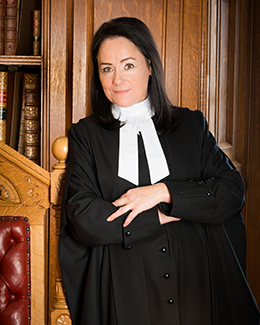
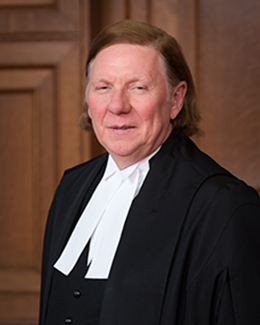





Located behind the main courtroom, the judges’ conference room is where the judges meet, usually to discuss and deliberate cases before and after hearings. It is also the assembly point for their procession into the courtroom.
The judges’ conference room also houses many rare books, including common and civil law books dating from the 17th century.
-HDR-Edit.jpg)
In some cases, the Court will render its decision orally at the end of the hearing, but most of the time it reserves judgment to enable the judges to write considered reasons. Decisions of the Court do not need to be unanimous. A majority of judges may decide and the minority will give dissenting reasons. Each judge can write reasons in any case if they choose to do so.
When a judgment is delivered in a case reserved for decision, the parties are notified and the formal judgment is deposited with the Registrar with all the written reasons. Judgments are published simultaneously in both official languages in the Canada Supreme Court Reports.
Consult Supreme Court of Canada judgments on our website.
decisions.scc-csc.ca
Cases come to the Supreme Court in 1 of 3 ways:
-
Leave to appeal: In most cases, a party who wants to appeal the decision of another court, usually a provincial or territorial court of appeal or the Federal Court of Appeal, must get permission from the Court.
-
Appeals as of right: There are cases for which leave to appeal (permission) is not required. These include appeals from opinions pronounced by courts of appeal on matters referred to them by a provincial government. They can also include certain criminal cases, for example, an appeal may be brought as of right when 1 judge in the court of appeal has dissented on a point of law.
-
References: The Court also hears references when the federal government requests an advisory legal opinion. Reference cases often ask if proposed or existing legislation is constitutional, for example, whether the federal government has the right to legislate certain activities. These are counted as appeals as of right for the purposes of these statistics.

In 2024:
- the Court received 526 applications for leave to appeal and 17 notices of appeal as of right
- the Court heard 39 appeals over 40 hearing days
- the Court issued 50 decisions, 8 of which were pronounced on the bench (“oral judgments”)
- all judges agreed in the result of the appeal in 38% of the judgments
The main courtroom is only used by the Supreme Court and occupies the centre of the building on the first floor. It measures 12 metres by 16 and has black walnut walls between fluted pilasters. 6 tall windows open to the naturally lit interior courtyards, which also serve as buffers to protect from outside noise.
Judges: Sit in order of seniority to the right and left of the chief justice or presiding judge. The minimum number of judges required to hear an appeal is 5. However, most cases are heard by panels of 7 or 9 judges.
Counsel for the appellants: The appellant is the party that is appealing the decision from the court of appeal.
Counsel for the respondents: The respondent is the party that opposes the appellant.
Counsel for the interveners: Interveners appear by videoconference and have 5 minutes to add arguments from a different perspective. They represent third parties who also have a vested interest in the outcome of the case.
Court attendant: Assists judges during hearings.
Registry officer: Manages the hearing and maintains records of the hearing.
Media: Members of the media attending the hearings.
Law clerks: Each judge is assisted by law clerks, recent law school graduates who help with legal research.
Public: Hearings are open to the public and live-streamed. The Court holds 3 sessions per year. Schedules of hearings are available on the Court’s website.

On-site tours

Come explore the Court in person. On-site tours:
- are suitable for all age groups
- take about 30 minutes
- can accommodate groups of up to 50 people
- are offered free of charge
September to April
9 am to 5 pm, Monday to Friday
Guided tours are available by reservation only
May and June
9 am to 5 pm daily, including weekends and holidays
Guided tours are available by reservation only from Monday to Friday
Guided tours are offered without a reservation on Saturday and Sunday
July and August
9 am to 5 pm daily, including weekends and holidays
Guided tours are offered without a reservation throughout the day
Guided tours may be shortened or cancelled without notice due to the work of the Court.
Remote tours

If you can’t come to the Supreme Court of Canada, the Court can come to you. Remote tours are offered live by our Guide Interpreters, who will teach you about the Court and its history through pictures and interesting facts.
Remote tours:
- are offered from 9 am to 4:30 pm Eastern Time, Monday to Friday
- are suitable for all age groups
- take about 30 minutes
- can accommodate groups of up to 50 people
- are offered free of charge
Reservations for remote tours must be made in advance. Book a tour now.
Tour information and reservations
Email: tour-visite@scc-csc.ca
Tel: 613-995-5361
Toll free: 1-866-360-1522
General inquiries
Email: reception@scc-csc.ca
Tel: 1-888-551-1185
Mailing address
301 Wellington Street
Ottawa, Ontario
K1A 0J1