
Quarterly financial report – Quarter ending June 30, 2026
Office of the Registrar of the Supreme Court of Canada
1. Introduction
This quarterly financial report has been prepared by management as required by section 65.1 of the Financial Administration Act and in the form and manner prescribed by the Treasury Board (TB). It should be read in conjunction with the Main Estimates. This report has not been subject to an external audit or review.
1.1 Authority, mandate and programs
Created by an Act of Parliament in 1875, the Supreme Court of Canada is Canada’s final court of appeal. It serves Canadians by deciding legal issues of public importance, thereby contributing to the development of all branches of law applicable within Canada. The independence of the Court, the quality of its work and the esteem in which it is held both in Canada and abroad contribute significantly as foundations for a secure, strong and democratic country founded on the rule of law. The Supreme Court of Canada is an important national institution, positioned at the pinnacle of the judicial branch of government in Canada, separate from and independent of the executive and legislative branches of government.
The Office of the Registrar of the Supreme Court of Canada (ORSCC) provides all necessary services and support for the Court to process, hear and decide cases. It also serves as the interface between litigants and the Court.
Further information on the ORSCC’s authority, mandate and programs may be found in its 2026–27 Main Estimates.
1.2 Basis of presentation
This quarterly report has been prepared by management using an expenditure basis of accounting. The accompanying Statement of Authorities includes the ORSCC’s spending authorities granted by Parliament and those used by the ORSCC, consistent with the 2026–27 Main Estimates. This quarterly report has been prepared using a special purpose financial reporting framework designed to meet financial information needs with respect to the use of spending authorities.
The authority of Parliament is required before money can be spent by the Government. Approvals are given in the form of annually approved limits through appropriation acts or through legislation in the form of statutory spending authority for specific purposes.
The ORSCC uses the full accrual method of accounting to prepare and present its annual departmental financial statements that are part of the departmental results reporting process. However, the spending authorities voted by Parliament remain on an expenditure basis.
2. Highlights of the fiscal quarter and the fiscal year-to-date (YTD) results1
This section highlights the changes in authorities provided and expenditures incurred as at June 30, 2026 compared to the same quarter of the prior year. Overall, both the ORSCC’s authorities and quarterly spending increased by 4.8% over the same quarter ending June 30, 2025. The overall proportion of authorities used on a year-to-date basis (20.0%) is the same as the previous year (20.0%).
2.1 Changes to granted authorities
As at June 30, 2026, the total authorities provided to the ORSCC have increased by $2,414,000 compared to the same quarter of the prior year. This net increase consists of:
- A net increase in Vote 1 – Net operating expenditures ($2,007,000); and
- A net increase in Statutory authorities ($407,000).
The net increase of $2,007,000 in Vote 1 – Net operating expenditures consists of:
- A net increase of $1,759,000 for funding reprofiled for the West Memorial Building move;
- An increase of $96,000 for allocation from TB Vote 15 (Collective agreements); and
- A net increase of $152,000 in funding received to invest in Security, Communications and Outreach, Corporate Services and Information Technology.
The net increase of $407,000 in Statutory authorities consists of:
- A net increase of $296,000 in contributions to employee benefit plans mainly due to rate adjustments; and
- A net increase of $111,000 in funding for Judges’ salaries, allowances, as well as annuities for retired Judges or their spouse.
2.2 Significant changes to budgetary expenditures
As at June 30, 2026, total net budgetary expenditures increased by 4.8% ($479,000) compared to the same quarter of the previous year. This variance comprises:
- A net increase of 5.8% ($447,000) in Vote 1 – Net operating expenditures; and
- A net increase of 1.4% ($32,000) in Statutory expenditures.
The above net increase of 5.8% ($447,000) noted in Vote 1 – Net operating expenditures is attributed to:
- A net salary increase of $267,000 in comparison to the same period last fiscal year mainly due to general increases in expenditures; and
- A net non-salary increase of $180,000 resulting from:
- Timing differences;
- Price variances;
- Special projects; and
- Fluctuating replacement or maintenance schedules.
The net increase of 1.4% ($32,000) in Statutory expenditures in comparison to the same quarter of the previous year is attributed to general increases in statutory operating expenditures.
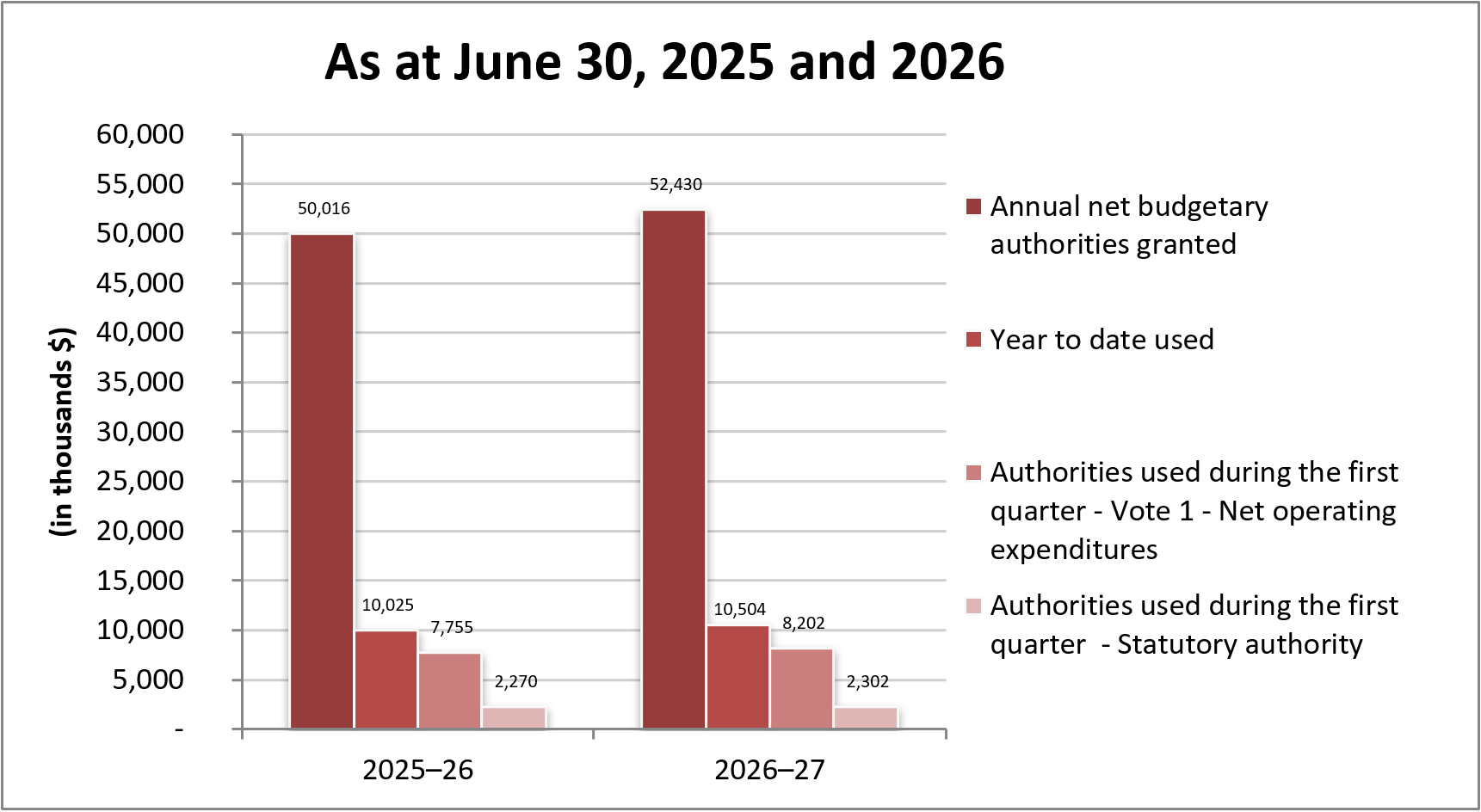
Text description of Figure 1
Comparison of first quarter authorities granted and used:
The diagram illustrates the variation in thousands of dollars for the annual net budgetary authorities granted, the authorities used – Vote 1 – Net operating expenditures and the authorities used – Statutory authorities as at June 30, 2025 and 2026.
Annual net budgetary authorities granted:
Figures showing authorities available for use as at June 30, 2025 and 2026: $50,015,976 in 2025–26 and $52,430,167 in 2026–27.
Year to date used:
Figures present the cumulative amounts the ORSCC spent as at June 30, 2025 and 2026 respectively: $10,025,315 and $10,504,092.
Authorities used during the first quarter – Vote 1 – Net operating expenditures:
Figures showing the amounts the ORSCC spent: $7,755,071 for the first quarter of 2025–26 and $8,202,326 for the first quarter of 2026–27.
Authorities used during the first quarter – Statutory authorities:
Figures showing the amounts the ORSCC spent: $2,270,244 for the first quarter of 2025–26 and $2,301,766 for the first quarter of 2026–27.
3. Risks and uncertainties
This departmental quarterly financial report reflects the results of the current fiscal period in relation to the 2026–27 Main Estimates for which full supply was released on June 19, 2026.
The ORSCC is funded through voted parliamentary spending authorities (71.5%) and statutory authorities (28.5%) for operating and personnel expenditures.
The environment and context in which the Court manages and decides cases is continuously evolving, which in turn produces new risks and challenges. The ORSCC dedicates time and effort to ensure that all resources are used in the most efficient and effective manner possible. Opportunities aimed at increasing efficiency and reducing costs remain a priority for the organization. Greater financial controls and improved resource planning, forecasting and investment prioritization are also contributing to mitigate these risks.
The upcoming relocation of the Supreme Court of Canada to the West Memorial Building is underway. The relocation involves a number of planning and coordination activities. The organization continues to follow progress closely and works collaboratively with Public Services and Procurement Canada (PSPC) to support a smooth transition.
4. Significant changes to operations, personnel and programs
The ORSCC is in the process of relocating to the West Memorial Building, with transition activities ongoing.
On June 30, 2026, the Prime Minister, Mark Carney, announced the appointment of the Honourable Glenn D. Joyal to the Supreme Court of Canada. This appointment fills the vacancy created by the retirement of the Honourable Justice Sheilah L. Martin on May 30, 2026.
There were no other significant changes in the ORSCC’s operations, personnel and programs over this reporting period.
Approval by senior officials
Approved by:
Chantal Carbonneau, Registrar
Catherine Laforce, Chief Financial Officer
Ottawa, Ontario
August 11, 2026
Statement of authorities (unaudited)
Fiscal year 2026–27
| Total available for use for the year ending March 31, 20272 | Used during the quarter ended June 30, 2026 | Year to date used at quarter-end | |
|---|---|---|---|
| Vote 1 - Net operating expenditures | 37,464,713 | 8,202,326 | 8,202,326 |
| Judges' salaries, allowances & annuities | 10,555,565 | 1,199,294 | 1,199,294 |
| Contributions to employee benefit plans | 4,409,889 | 1,102,472 | 1,102,472 |
| Spending of amounts equivalent to proceeds from disposal of surplus moveable Crown assets | - | - | - |
| Statutory authorities | 14,965,454 | 2,301,766 | 2,301,766 |
| Total authorities | 52,430,167 | 10,504,092 | 10,504,092 |
Fiscal year 2025–26
| Total available for use for the year ending March 31, 20262 | Used during the quarter ended June 30, 2025 | Year to date used at quarter-end | |
|---|---|---|---|
| Vote 1 - Net operating expenditures | 35,457,459 | 7,755,071 | 7,755,071 |
| Judges' salaries, allowances & annuities | 10,444,278 | 1,241,798 | 1,241,798 |
| Contributions to employee benefit plans | 4,113,785 | 1,028,446 | 1,028,446 |
| Spending of amounts equivalent to proceeds from disposal of surplus moveable Crown assets | 454 | - | - |
| Statutory authorities | 14,558,517 | 2,270,244 | 2,270,244 |
| Total authorities | 50,015,976 | 10,025,315 | 10,025,315 |
Departmental budgetary expenditures by standard object (unaudited)
Fiscal year 2026–27
| Planned expenditures for the year ending March 31, 20272 | Expended during the quarter ended June 30, 2026 | Year to date used at quarter-end | |
|---|---|---|---|
| Expenditures | |||
| Personnel | 41,437,524 | 9,113,567 | 9,113,567 |
| Transportation and communications | 1,360,236 | 237,035 | 237,035 |
| Information | 1,007,467 | 71,962 | 71,962 |
| Professional and special services | 4,233,437 | 485,835 | 485,835 |
| Rentals | 1,368,578 | 430,601 | 430,601 |
| Repair and maintenance | 394,316 | 21,326 | 21,326 |
| Utilities, materials and supplies | 757,848 | 133,463 | 133,463 |
| Acquisition of machinery and equipment | 1,840,046 | 41,268 | 41,268 |
| Other subsidies and payments | 30,715 | (30,965) | (30,965) |
| Total net budgetary expenditures | 52,430,167 | 10,504,092 | 10,504,092 |
Fiscal year 2025–26
| Planned expenditures for the year ending March 31, 20262 | Expended during the quarter ended June 30, 2025 | Year to date used at quarter-end | |
|---|---|---|---|
| Expenditures | |||
| Personnel | 41,028,047 | 8,770,430 | 8,770,430 |
| Transportation and communications | 1,295,236 | 175,079 | 175,079 |
| Information | 572,260 | 87,261 | 87,261 |
| Professional and special services | 2,992,236 | 486,178 | 486,178 |
| Rentals | 1,413,736 | 328,441 | 328,441 |
| Repair and maintenance | 329,204 | 12,541 | 12,541 |
| Utilities, materials and supplies | 1,304,183 | 140,904 | 140,904 |
| Acquisition of machinery and equipment | 1,020,303 | 26,332 | 26,332 |
| Other subsidies and payments | 60,771 | (1,851) | (1,851) |
| Total net budgetary expenditures | 50,015,976 | 10,025,315 | 10,025,315 |