
Message from the Chief Justice of Canada
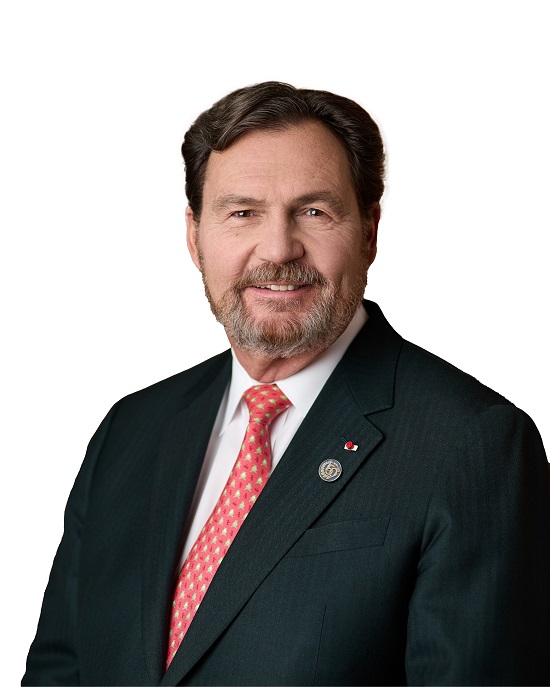
This Year in Review is a special edition to commemorate a significant milestone in our country’s history: the 150th anniversary of the Supreme Court of Canada. Since its establishment in 1875, the work of the Court is hearing and deciding cases of public importance. But the Court is more than an arbiter of the law. For 150 years, it has also upheld the rule of law, built public trust, and served our community. Together, these values are the theme of the Court’s anniversary.
Upholding the rule of law means ensuring that no one is above the law and that justice is applied fairly and impartially. The Court remains steadfast in its commitment to decisions that respect the Constitution and the democratic principles on which Canada is founded.
Building public trust is essential to the Court’s legitimacy. We strive to be transparent, accessible, and independent, recognizing that public confidence is vital for a strong and healthy democracy.
Serving our community speaks to our duty to all Canadians. Every case that comes before the Court carries a human dimension. Our decisions help shape the rights and responsibilities we all share, and ultimately, the society we live in together.
As we reflect on the past 150 years, we also look ahead with purpose and a deep and continuing commitment to justice. On behalf of my colleagues at the Supreme Court of Canada and myself, thank you for placing your trust in our institution. We are honoured to serve you.
“Throughout the year, we held events to mark this anniversary and honour these values. I would like to thank everyone who participated in these commemorations, from all parts of the country and around the world. It was an honour meeting so many of you, both at the Court and in your communities.”

Chief Justice of Canada
Judges of the Supreme Court of Canada
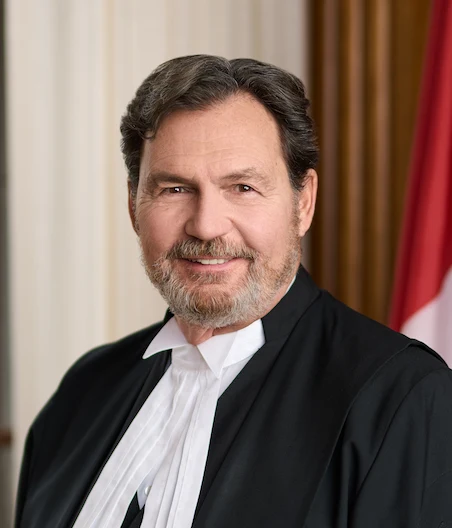
Chief Justice of Canada Appointed in 2012
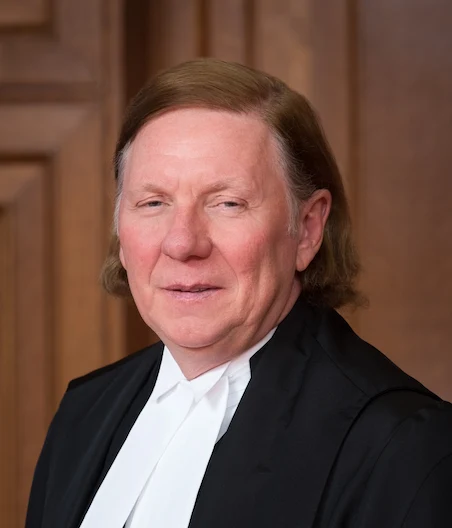
Appointed Chief Justice of Canada in 2017








Message from the Registrar

As Registrar of the Supreme Court of Canada, it is my privilege to lead the employees who support with excellence the highest court in the country. The dedication and professionalism of our staff are essential to the Court’s function and allow it to process, hear, and decide the cases before it each year.
The Court commemorated its 150th anniversary with a number of initiatives. Judges notably travelled to five cities across the country to speak about the work of the Court and engage with Canadians. Thanks to the tireless efforts of Court staff, these visits and the many other events that took place this year were a resounding success. Special exhibits, developed in partnership with Library and Archives Canada, the Senate of Canada, and Canadian Heritage, enriched our visitor experience by tracing the history of the Court from its beginnings to today. On April 8th, the date of our anniversary, the Royal Canadian Mint issued a $1 circulation coin commemorating the 150th anniversary of the Supreme Court of Canada. How exciting to see a tangible representation of our history in the hands of Canadians!
While browsing the exhibits about the creation of the Court displayed throughout the year, I saw the thread connecting Court employees from 1875 to those working away in the offices around me today. From its beginnings, the Court has been staffed with remarkable professionals who bring us their knowledge and innovation, while paying tribute to our traditions.
I was thrilled to highlight employees who reached important milestones in their careers as public servants during our Long Service Award Ceremony.
I also had the honour of highlighting their exceptional work, which continuously improves access to the Court and its services.
On top of their professional achievements, Court staff also celebrated the impressive $41,900 they raised as part of the Government of Canada Workplace Charitable Campaign.
Although we are reflecting on our past, we are looking to the future of the Court with enthusiasm. Planning for the rehabilitation of the Supreme Court of Canada building is advancing well, as are the preparations to move the Court’s judges and staff to the West Memorial Building, located at 344 Wellington Street. We are already contemplating new ways to better serve the public in this new space.
I am filled with pride thinking of everything we have achieved in 2025, an extraordinary year for the Supreme Court of Canada. As 2026 begins, Court staff are turning to the decades to come, serving Canadians with the same diligence that has defined them for 150 years.

Chantal Carbonneau
Registrar
Supreme Court of Canada


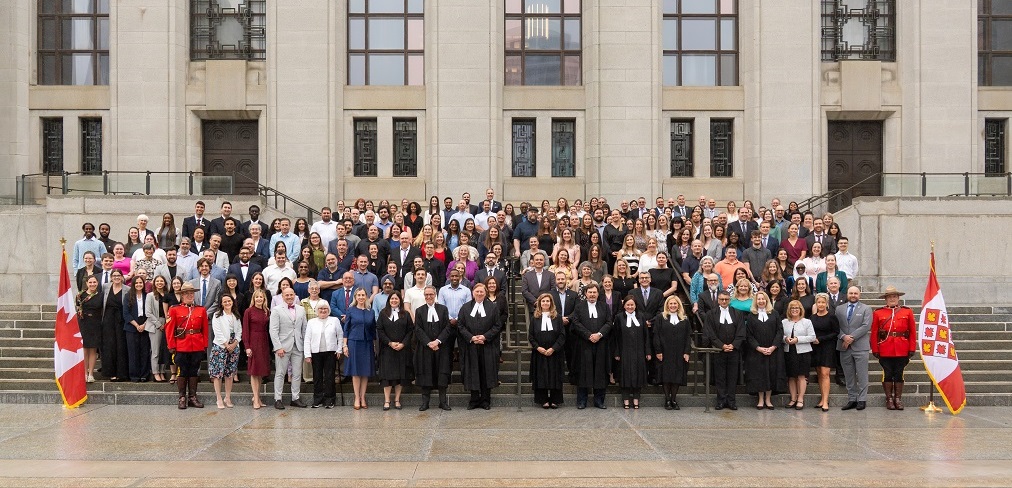


About the Supreme Court of Canada
Canada’s highest court
The Supreme Court is Canada’s final court of appeal. It has final jurisdiction over disputes in every area of the law. Since its creation 150 years ago, the Court has helped shape Canada’s legal landscape and strengthen our democracy by ensuring that the rule of law is upheld.
The Supreme Court consists of nine judges, including the Chief Justice of Canada. By law, three judges must come from Quebec, to represent the civil law system. The Court is both bilingual and bijural: cases are heard in English and French, and the Court applies both the common law and civil law systems.
The Supreme Court hears appeals, not trials. Judges study written and oral arguments, ask questions and may hear from interveners who bring broader perspectives.
Independent and impartial, the Court plays a vital role in Canada’s system of government. Alongside the legislative and executive branches, the judicial branch ensures that laws and government actions comply with the Constitution.
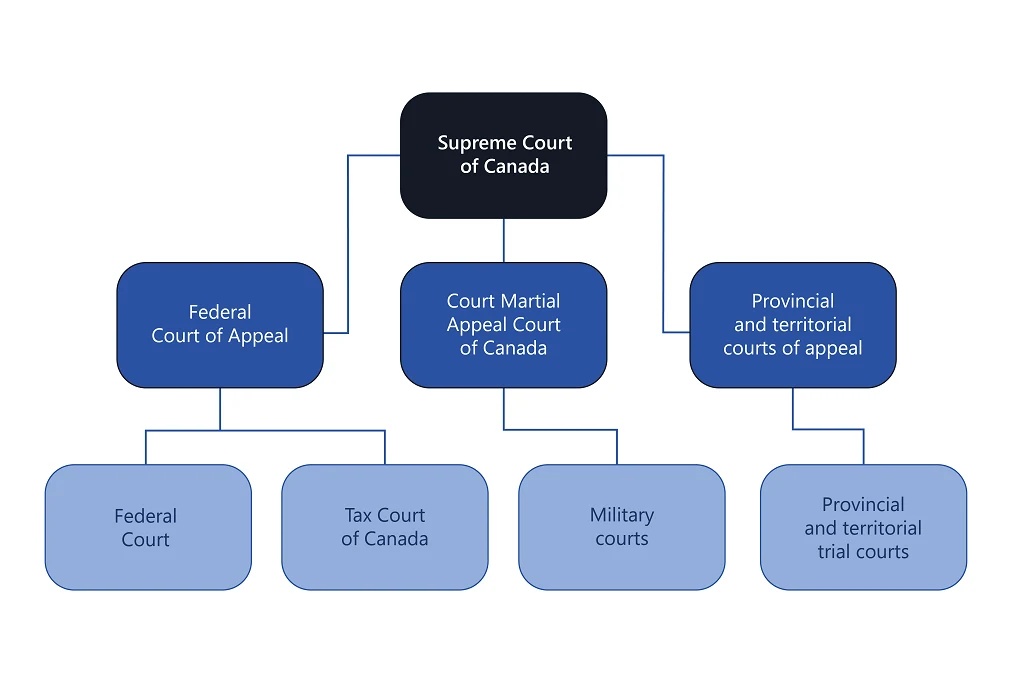
How the courts are organized
The courts in Canada are organized in a pyramid structure. The Supreme Court of Canada sits at the top of the structure and hears appeals from cases that have been decided in the federal court system or in the provincial and territorial court systems.
The rule of law
The rule of law is the foundation of Canada’s democracy. It means that everyone is subject to the law, and that the law is applied equally and fairly to all.
In an era marked by political polarization, misinformation, and challenges to democratic institutions both at home and abroad, protecting the rule of law is more important than ever. Judicial independence is central to this protection. It ensures that judges can make decisions based only on the law and the facts, free from outside influence.
An impartial judiciary promotes fairness, upholds accountability, and strengthens public trust in democratic governance. These principles are essential to a healthy democracy and the Supreme Court plays a vital role in safeguarding them.
“The Court ensures that the rule of law is not just a legal principle, but the bedrock of our democratic society.”
The Right Honourable Richard Wagner, P.C.
Chief Justice of Canada
How cases come to the Supreme Court
Cases reach the Supreme Court in one of three ways. Most commonly, a party must first ask the Court for permission, or “leave”, to appeal a decision from a lower court such as a provincial or territorial court of appeal, the Federal Court of Appeal, or the Court Martial Appeal Court of Canada. The Supreme Court grants leave only when a case raises issues of public importance in law or in mixed questions of law and fact, as set out in section 40 of the Supreme Court Act. The Court does not give reasons for its decisions on leave applications.
In other instances, parties have an automatic right to appeal, meaning that leave is not required. For example, in some types of criminal cases, an appeal may be brought before the Court as of right when one judge in the court of appeal has dissented on a point of law. To exercise this right, the party simply files a notice of appeal.
Finally, the Court also provides advisory opinions through reference cases. These cases often ask if a proposed or existing legislation is constitutional. For example, a reference case might consider whether the government has the right to legislate certain activities. Over the years, the Supreme Court has answered a wide variety of reference questions dealing with issues of national significance, from same-sex marriage and Senate reform to climate change and beyond.
Judgments of the Court
In 2025, the Supreme Court of Canada continued to carry out its mission of interpreting and upholding the rule of law. Throughout the year, it rendered judgments across a wide range of core areas in Canadian law, including constitutional and criminal law, administrative law, and property law.
Many of the Court’s decisions explored the scope of protections under the Canadian Charter of Rights and Freedoms, from procedural fairness in correctional settings to the balance between freedom of expression and electoral fairness. A large proportion of the cases heard this year dealt with issues of criminal law. In its decisions, the Court refined principles governing sentencing, mental health, and fitness to stand trial. It reaffirmed the importance of proportionality, rehabilitation, and individualized justice within Canada’s criminal law framework.
Beyond the criminal field, the Court addressed issues of economic and social significance, such as access to insolvency relief for student debtors and the accountability of public institutions under modern regulatory regimes.
As it enters its next century and a half of service to the Canadian population, the Supreme Court remains central to the evolution of Canadian jurisprudence. Its decisions continue to shape the interpretation of fundamental rights, strengthen public confidence in the justice system, and guide the development of the law in a democratic society founded on fairness, equality, and respect for human dignity.
Landmark decision
John Howard Society of Saskatchewan v. Saskatchewan (Attorney General)
2025 SCC 6 | March 14, 2025
On March 14, 2025, the Supreme Court issued a landmark decision holding that the standard of proof of guilt beyond a reasonable doubt applies in inmate disciplinary proceedings.
Inmates charged with disciplinary offences in Saskatchewan’s provincial correctional institutions must appear before a disciplinary panel to answer to those charges. Under section 68 of Saskatchewan’s Correctional Services Regulations, 2013 (“Regulations”), the standard of proof in such proceedings is a balance of probabilities, meaning it must be more likely than not that the inmate committed the offence. This standard of proof is used in all disciplinary proceedings, including major offences for which sanctions can include disciplinary segregation for up to 10 days or loss of earned remission for up to 15 days.
The John Howard Society of Saskatchewan challenged the Regulations, asserting that the presumption of innocence requires that the standard of proof in disciplinary proceedings be proof of guilt beyond a reasonable doubt. In the lower courts, the John Howard Society based this argument only on section 7 of the Canadian Charter of Rights and Freedoms, which guarantees the right to life, liberty, and security of the person except in accordance with the principles of fundamental justice. The John Howard Society could not rely on section 11(d) of the Charter, which provides that any person charged with an offence has the right to be presumed innocent until proven guilty, because of the Supreme Court of Canada’s decision in R. v. Shubley, [1990] 1 S.C.R. 3. In that case, the Court held that inmate disciplinary proceedings, including disciplinary segregation and loss of earned remission, do not engage section 11 of the Charter.
The application judge held that section 68 of the Regulations does not violate section 7 of the Charter, concluding that neither the nature of inmate disciplinary proceedings, nor the severity of disciplinary segregation and loss of earned remission necessitated the heightened standard of proof of guilt beyond a reasonable doubt. The Court of Appeal agreed.
The John Howard Society appealed the section 7 issue to the Supreme Court. It also raised, as a new constitutional issue, the question of whether section 68 of the Regulations infringes section 11(d) of the Charter.
Chief Justice Wagner, writing for the majority of the Supreme Court, allowed the appeal. The Court concluded that section 68 of the Regulations infringes sections 7 and 11(d) of the Charter because it permits the imposition of imprisonment when a reasonable doubt as to the accused’s guilt may exist. The conclusion drawn in Shubley, that disciplinary segregation and loss of earned remission do not engage section 11 because they do not amount to imprisonment, has been attenuated by the Supreme Court’s consistent direction that judges must interpret the Charter in a generous, rather than a formalistic, manner that gives effect to the purpose of the rights guarantee in question.
Notable decisions
A civil society organization, several unions, and individual citizens challenged the constitutionality of Ontario’s Election Finances Act (“EFA”) spending limit on third parties, arguing that the provision infringes the right to vote guaranteed by section 3 of the Canadian Charter of Rights and Freedoms. The application judge concluded that the challenged provision did not violate section 3 as the law respected the right of voters to meaningfully participate in the electoral process through an informed vote.
The Supreme Court dismissed the appeal. It concluded that a spending limit will infringe section 3 of the Charter if it allows political actors or third parties a disproportionate voice in the political discourse given their roles in the electoral process. Writing for the majority of judges, Justice Karakatsanis concluded that the third party spending limit in section 37.10.1(2) of the EFA infringes the right to vote in section 3 of the Charter and is therefore constitutionally invalid. By design, section 37.10.1(2) creates absolute disproportionality, which is a disproportionality that is so marked on its face that it allows political parties to drown out the voices of third parties on political issues from reaching citizens during an entire year of legislative activity. As Justice Karakatsanis wrote, “[m]eaningful participation in the electoral process includes an informed vote, as it is only with access to information that citizens can vote in a way that accurately reflects their preferences”.
This appeal asked the Supreme Court to clarify when government-issued student loan debts are released under the Bankruptcy and Insolvency Act (“BIA”). Ms. Piekut pursued several post-secondary education programs between 1987 and 2009. She received federal student loans for all her post-secondary education programs, except for her Master of Education, which she financed herself.
In 2013, Ms. Piekut made a consumer proposal under the BIA. A consumer proposal is a legally binding agreement between a consumer and their creditors. It offers an alternative to bankruptcy, allowing the consumer to repay a portion of their debts over a set period, while avoiding the loss of assets.
The Supreme Court dismissed Ms. Piekut’s appeal. Ms. Piekut ceased to be a student in 2009, four years before her consumer proposal. Writing for a majority of judges, Justice Jamal said that because Ms. Piekut was a full- or part-time student until 2009 and filed a consumer proposal only four years later in 2013, she could not be released from her student loan debt by sections 178(1)(g)(ii) and (2) of the BIA. Interpreting section 178(1)(g)(ii) based on its text, context, and purpose, Justice Jamal concluded that the date on which a bankrupt ceases to be a student is the last time they stopped being a student before they declared bankruptcy.
Consult the case information for Piekut v. Canada (Minister of National Revenue)
This appeal was about whether a sentencing judge may consider the time an offender needs to complete rehabilitative programming when deciding the length of a sentence. This appeal also addressed the factors the sentencing judge may consider when deciding whether an offender is entitled to “enhanced credit” for time spent in detention.
In 2018, J.W., an Indigenous man with significant cognitive impairments, was living in a group home where he violently sexually assaulted a staff member. A few months later, J.W. pled guilty to sexual assault, threatening to cause death, and unlawful confinement. He was arrested and held in custody pending trial. In 2020, J.W. was admitted to a mental health facility for a court-ordered assessment and, in January 2021, he was found unfit to stand trial. A few months later he was found fit to stand trial and ultimately pled guilty in November 2021.
The Supreme Court allowed J.W.’s appeal in part. It said that the actions in delaying proceedings were a consequence of his mental health, and did not amount to wrongful conduct that justified denying enhanced credit. Writing for a unanimous Court, Justice Rowe said that when there is a sufficient evidentiary basis on the availability and accessibility of institutional programming, it is not an error in principle for the sentencing judge to consider an offender’s anticipated time to complete it as a factor in the individualized sentencing process. The sentence arrived at, however, must be proportionate to the gravity of the offence and the degree of responsibility of the offender.
In 2018, Ms. Pepa entered Canada from Albania with a permanent resident visa as an accompanying dependent child of her father. In order to be considered an accompanying dependent child, the person must be unmarried. At the border, Ms. Pepa disclosed that she had recently married, which meant that she no longer met the criteria to be a dependent child. The Canadian immigration rules require that a change in marital status be reported before entry into Canada. Because of the change in her marital status, she could not be granted permanent resident status as a dependent child and was instead admitted into the country for further investigation. When she entered Canada, Ms. Pepa was the holder of a valid permanent resident visa. However, her visa expired before the end of the investigation.
Ms. Pepa had an admissibility hearing (a hearing to decide if a person is allowed to stay in Canada or not) nine days after the expiration of her visa. The result of the hearing was that a removal order was issued against her, barring her from entering Canada. She appealed the decision to the Immigration Appeal Division (“IAD”), but it was unsuccessful.
The Supreme Court allowed the appeal, set aside the previous decisions, and remitted the matter to the IAD for determination of Ms. Pepa’s appeal from the removal order. Writing for a majority of the judges of the Court, Justice Martin concluded that in this case, it was unreasonable for the IAD to find that it does not have jurisdiction to hear an appeal of a removal order pursuant to section 63(2) of the Immigration and Refugee Protection Act if the permanent resident visa is expired at the time the removal order is issued. The IAD’s reasons lack internal rationality and demonstrate a failure of justification, based on the relevant precedents, the applicable principles of statutory interpretation, and the potential impact of the decision on Ms. Pepa.
Consult the case information for Pepa v. Canada (Citizenship and Immigration)
This appeal asked the Court to clarify when a Superior Court judge can order a judge-alone trial for a murder charge, despite the Crown’s refusal to consent.
Mr. Varennes was charged with the second degree murder of his spouse. His jury trial was scheduled for September 2020, during the COVID-19 pandemic. In June 2020, he requested a judge-alone trial, which is allowed for a murder charge under the Criminal Code if both the accused and the Crown consent to this mode of trial. Mr. Varennes argued that potential pandemic-related delays to jury trials risked violating his right to be tried within a reasonable time as set out in section 11(b) of the Canadian Charter of Rights and Freedoms. Crown prosecutors refused to consent to a judge-alone trial.
The Supreme Court allowed Mr. Varennes’ appeal, set aside the Court of Appeal’s judgment, and sent the matter back to the Court of Appeal to decide the Crown’s other grounds of appeal. Writing for a majority of the Court, Justice Karakatsanis said that the Court of Appeal had jurisdiction to hear the Crown’s appeal of the trial judge’s decision to hold a judge-alone trial. However, the Court of Appeal erred by requiring proof that the Crown’s refusal to consent to a judge-alone trial was an abuse of process, and in ordering a new trial. A decision of the Crown to consent or not to a judge-alone trial does not fall within the Crown’s core prosecutorial discretion and can be reviewed by a superior court under its inherent jurisdiction, on a standard lower than abuse of process.
This appeal was about how the Youth Criminal Justice Act (YCJA) should be interpreted when deciding if a young person should receive an adult sentence.
The appellant participated in a planned robbery with intent to steal a firearm from a seventeen-year-old. The appellant and his co-assailants attacked the victim outside his residence. They beat him and stabbed him. The victim died from his wounds. The appellant and his co-assailants then entered the victim’s home, pistol-whipped the victim’s mother, and searched the home for firearms.
The appellant was charged with and convicted of first degree murder. The sentencing judge imposed an adult sentence, concluding that the appellant had the maturity of an adult and that a youth sentence would not suffice. The Court of Appeal upheld that decision.
Writing for the majority, Justice Kasirer said that on a proper interpretation of section 72(1)(a) of the YCJA, the Crown must rebut the statutory presumption of diminished moral blameworthiness beyond a reasonable doubt. Furthermore, in determining whether the Crown has successfully rebutted this presumption, a court should not consider the seriousness or objective gravity of the offence; rather, it should consider factors that focus on the young offender’s developmental age and capacity for moral judgment.
In this case, at the first threshold step in the section 72(1)(a) analysis, the sentencing judge applied the wrong standard, erred in considering the seriousness of the offence and failed to properly consider other factors. Accordingly, the sentence imposed by the sentencing judge is not deserving of deference on appeal. The appellant must therefore be properly sentenced as a young person pursuant to the youth sentencing regime in the YCJA.
In 2014, Parliament enacted legislation that created new offences. These included making money from someone else’s sex work (the material benefit offence) and helping arrange sex work for money (the procuring offence). Mr. Kloubakov and Mr. Moustaine, who worked as drivers for an escort business, were convicted of those new offences. However, the trial judge found that the offences deprived sex workers of the ability to take the safety measures contemplated in Canada (Attorney General) v. Bedford, 2013 SCC 72, and therefore violated their rights under section 7 of the Charter. She entered a stay of proceedings (meaning she stopped the case). The Alberta Court of Appeal overturned that decision, restored the convictions, and referred the case back to the trial court for sentencing. Messrs. Koublakov and Moustaine then appealed to the Supreme Court.
In a unanimous judgment, the Court held that in applying the modern principle of statutory interpretation, neither the material benefit offence nor the procuring offence prohibits the safety measures contemplated in Bedford. It explained that the material benefit offence is aimed at stopping people from profiting from others’ sex work in exploitative ways, but allows sex workers to hire drivers, security staff, and others to help keep them safe. The procuring offence only applies where someone deliberately tries to induce another person to sell sexual services, not those who rent space to sex workers or offer them advice on staying safe. As a result, the offences do not engage sex workers’ security of the person and do not infringe section 7 of the Charter. The convictions of the accused were affirmed.
This appeal addressed the question of whether an accused person with a history of serious mental illness was unfit to stand trial, and whether he could introduce new psychiatric evidence on appeal.
Mr. Bharwani, who has a long history of mental health challenges, was charged with killing his roommate. During the pre-trial proceedings, several concerns were raised regarding his fitness to stand trial. A jury ultimately found him fit to do so. At trial, Mr. Bharwani raised a defence of not criminally responsible on account of a mental disorder. The defence called two psychiatrists to testify as experts. They diagnosed the accused as having symptoms of schizophrenia and psychosis at the time of the offence, which prevented him from understanding the moral wrongfulness of his actions. The Crown also called a psychiatrist, who diagnosed the accused with schizophrenia but concluded he was capable of appreciating the nature and quality of his actions. A jury convicted him of first-degree murder.
The Supreme Court dismissed the appeal. Writing for a majority of the Court, Justice O’Bonsawin indicated that an accused is fit to stand trial when they are able to make and communicate decisions that are based in reality in the conduct of their defence or when instructing counsel to do so. In this case, deference should be shown to the trial judge’s determination that although the accused’s mental disorder prevented him from making decisions in his own best interests, there were no reasonable grounds to believe that he did not understand.
This case dealt with how sentencing decisions are reviewed on appeal. Sentencing judges have broad discretion, and appeal courts can only intervene if there was an error or a sentence is clearly unfit. The case also considered how modern sentencing principles apply to historical offences.
In the early 1990s, a teacher repeatedly abused a grade-seven student. A jury convicted the teacher of sexual interference and invitation to sexual touching. The sentencing judge identified aggravating factors and found no mitigating ones. After analysing these factors and the case law, the judge imposed six-year concurrent sentences, meaning six years of incarceration in total.
The Supreme Court allowed the appeal. Writing for a unanimous Court, Chief Justice Wagner said the Alberta Court of Appeal was wrong to reduce the sentence. The sentencing judge’s reasons were sufficient. The reasons do not need to spell out every detail if the essential facts are clear from the record and the jury’s verdict. In other words, a judge’s reasons must be read in context. In this case, the sentencing judge had correctly identified the aggravating factors and applicable principles. Chief Justice Wagner also explained that the goals of denunciation and deterrence required the balance of the sentence to be served in prison.
This case was about how a judge can consider the facts related to the offence for which the judge must sentence the offender. Specifically, the question was whether a judge can take into account any facts that gave rise to another criminal charge for a different offence even if it is no longer before the courts.
In 2021, Mr. Di Paola, a construction contractor, was charged with offences for having offered an advantage to an official in exchange for public contracts, in violation of the Criminal Code. He later made an agreement with the Crown that resulted in the most serious charge being withdrawn. He therefore pleaded guilty to a lesser offence. The judge who sentenced him considered the facts of the more serious charge as aggravating factors. Mr. Di Paola was given a 15 month conditional sentence, which means that the person serves their sentence in the community, under certain conditions, rather than in prison. Mr. Di Paola appealed the decision.
The Supreme Court allowed the appeal. The judgment was delivered orally by Chief Justice Wagner on the day of the hearing, with reasons to follow. Writing for the majority of the Supreme Court, Chief Justice Wagner stated that section 725(1)(c) of the Criminal Code authorizes a judge to consider any facts forming part of the circumstances of the offence even if those facts could give rise to a separate charge that was laid and then withdrawn. This rule gives the judge a full picture of the offender’s conduct and allows the judge to impose a fit and proportionate sentence.
The Supreme Court was asked whether a judge can review a refusal to move someone to a lower security prison because they are deprived of their liberty. Prisoners retain residual liberty, which is the level of freedom they have inside the institution. Security classification affects residual liberty because a higher security level means more supervision, limits on movement, and stricter daily routines. The law says that prisoners must be held in conditions that restrict their residual liberty as little as possible.
Messrs. Dorsey and Salah were both serving their sentences in medium-security federal institutions. Their case management teams recommended that each be transferred to a minimum-security prison. Senior correctional officials rejected those recommendations, keeping the inmates in more restrictive conditions. Messrs. Dorsey and Salah sought to reverse this decision in the Ontario Superior Court of Justice using habeas corpus. Habeas corpus requires a person under arrest to be brought before a judge to determine whether their detention is lawful. The judge dismissed both applications, saying that habeas corpus could not be used to review this type of decision. The Court of Appeal agreed.
The Supreme Court allowed the appeal. Writing the reasons of the majority of the Supreme Court, Justice Moreau said that habeas corpus is meant to be a broad and accessible remedy that protects against unlawful restraints on liberty. In the prison context, an inmate’s security classification directly affects their residual liberty. Keeping an inmate in a higher security facility after wrongly denying their request for reclassification is an unlawful restriction on the inmate’s residual liberty.
Consult the case information for Dorsey v. Canada (Attorney General)
All judgments
| Neutral citation | Case name | Origin | Decision date |
|---|---|---|---|
| 2025 SCC 2 | R. v. Bilodeau | Alberta | 2025-02-19 |
| 2025 SCC 3 | R. v. Chicoine-Joubert | Quebec | 2025-02-20 |
| 2025 SCC 9 | R. v. Chizanga | Ontario | 2025-03-24 |
| 2025 SCC 42 | R. v. DeSutter | Nova Scotia | 2025-12-05 |
| 2025 SCC 10 | R. v. Donawa | Ontario | 2025-03-26 |
| 2025 SCC 1 | R. v. Hanrahan | Newfoundland and Labrador | 2025-01-21 |
| 2025 SCC 11 | R. v. Kwon | Saskatchewan | 2025-03-27 |
| 2025 SCC 40 | R. v. Ouellet | Quebec | 2025-12-03 |
| 2025 SCC 8 | R. v. P.B. | Saskatchewan | 2025-03-21 |
| 2025 SCC 7 | R. v. R.A. | British Columbia | 2025-03-20 |
| 2025 SCC 14 | R. v. Underwood | Alberta | 2025-04-17 |
| 2025 SCC 37 | R. v. W.W. | Ontario | 2025-11-14 |
| 2025 SCC 44 | Ville de Sainte-Julie v. Investissements Laroda inc. | Quebec | 2025-12-19 |
| 2025 SCC 43 | R. v. Carignan | Quebec | 2025-12-12 |
| 2025 SCC 41 | R. v. B.F. | Ontario | 2025-12-05 |
| 2025 SCC 39 | Lundin Mining Corp. v. Markowich | Ontario | 2025-11-28 |
| 2025 SCC 38 | Dorsey v. Canada (Attorney General) | Ontario | 2025-11-21 |
| 2025 SCC 36 | R. v. Larocque | New Brunswick | 2025-11-14 |
| 2025 SCC 35 | R. v. Rousselle | New Brunswick | 2025-11-14 |
| 2025 SCC 34 | R. v. Rioux | Quebec | 2025-11-07 |
| 2025 SCC 33 | Attorney General of Quebec v. Senneville | Quebec | 2025-10-31 |
| 2025 SCC 32 | R. v. Wilson | Saskatchewan | 2025-10-24 |
| 2025 SCC 31 | R. v. Di Paola | Quebec | 2025-10-17 |
| 2025 SCC 30 | Mohawk Council of Kanesatake v. Sylvestre | Quebec | 2025-10-10 |
| 2025 SCC 29 | R. v. Sheppard | Alberta | 2025-09-26 |
| 2025 SCC 28 | Kosicki v. Toronto (City) | Ontario | 2025-09-19 |
| 2025 SCC 27 | Sinclair v. Venezia Turismo | Ontario | 2025-07-31 |
| 2025 SCC 26 | R. v. Bharwani | Ontario | 2025-07-25 |
| 2025 SCC 25 | R. v. Kloubakov | Alberta | 2025-07-24 |
| 2025 SCC 23 | R. v. I.M. | Ontario | 2025-07-18 |
| 2025 SCC 24 | R. v. S.B. | Ontario | 2025-07-18 |
| 2025 SCC 22 | R. v. Varennes | Quebec | 2025-07-11 |
| 2025 SCC 21 | Pepa v. Canada (Citizenship and Immigration) | F.C.A. | 2025-06-27 |
| 2025 SCC 20 | Dunmore v. Mehralian | Ontario | 2025-06-20 |
| 2025 SCC 19 | R. v. Kinamore | British Columbia | 2025-06-13 |
| 2025 SCC 18 | R. v. Bouvette | British Columbia | 2025-06-06 |
| 2025 SCC 17 | Opsis Airport Services Inc. v. Quebec (Attorney General) | Quebec | 2025-05-30 |
| 2025 SCC 16 | R. v. J.W. | Ontario | 2025-05-23 |
| 2025 SCC 15 | Telus Communications Inc. v. Federation of Canadian Municipalities | F.C.A. | 2025-04-25 |
| 2025 SCC 13 | Piekut v. Canada (Minister of National Revenue) | British Columbia | 2025-04-17 |
| 2025 SCC 12 | R. v. Pan | Ontario | 2025-04-10 |
| 2025 SCC 6 | John Howard Society of Saskatchewan v. Saskatchewan (Attorney General) | Saskatchewan | 2025-03-14 |
| 2025 SCC 5 | Ontario (Attorney General) v. Working Families Coalition (Canada) Inc. | Ontario | 2025-03-07 |
| 2025 SCC 4 | Saskatchewan (Environment) v. Métis Nation – Saskatchewan | Saskatchewan | 2025-02-28 |
| n/a1 | R. v. Vrbanic | Ontario | 2025-12-04 |
Related links
- Judgments – Learn more about the judgments of the Court.
- Case in Brief summaries – Read summaries of the Court’s decisions in plain language.
Commemorating 150 years
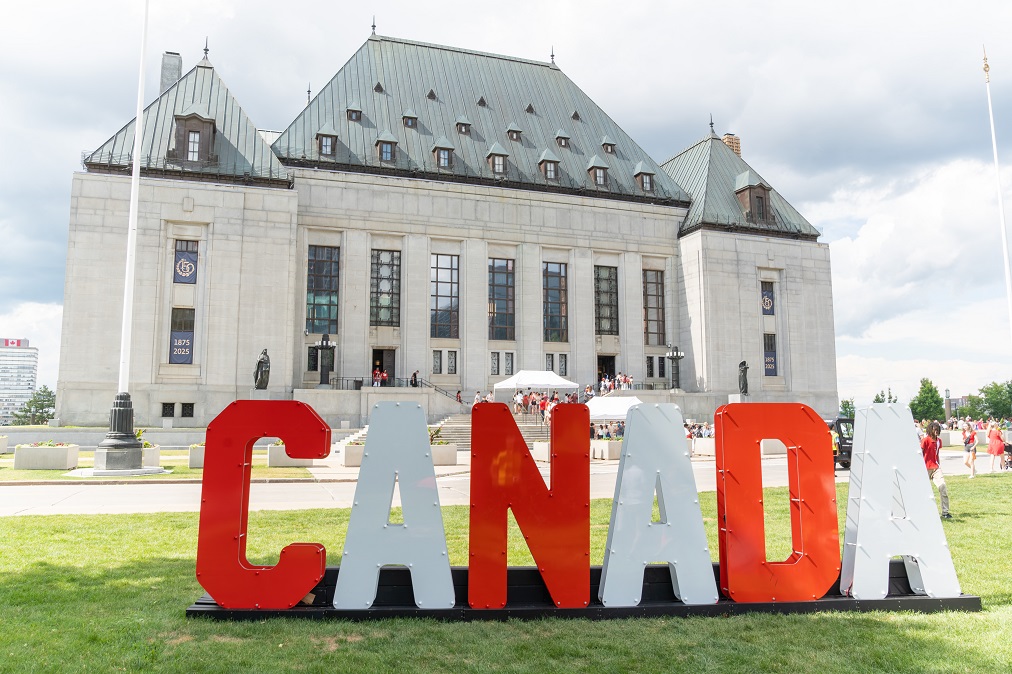
In 2025, the Supreme Court of Canada marked its anniversary under the theme 150 years of upholding the rule of law, building public trust, and serving our community.
Since its establishment in 1875, the Supreme Court has played a central role in strengthening Canadian democracy. By deciding legal issues of public importance, it has influenced the evolution of the country and ensured that the values and diversity of Canadian society are reflected in its work. Today, the Court continues this tradition as a modern institution committed to openness, transparency, and judicial independence.
A busy commemorative year
To honour this milestone anniversary, the Court organized events and activities throughout the year to bring Canadians together from across the country to reflect on its legacy and role in shaping our democracy.
The visits to five Canadian cities were among the highlights of the year, giving Supreme Court judges the opportunity to share their work and meet with diverse groups, including students, journalists, legal professionals, and the general public.
The Supreme and Exchequer Court Act was granted Royal Assent on April 8, 1875, creating the Supreme Court of Canada. With this anniversary in mind, the Court had a busy April as it launched a circulation coin with the Royal Canadian Mint, unveiled a new exhibit, and held a legal symposium.
Canadians also participated through a range of creative and educational initiatives. A photo exhibit on Plaza Bridge in the heart of downtown Ottawa invited passersby to explore the Court’s evolution. Commemorative banners along Confederation Boulevard proudly announced this important anniversary. Youth contributed through an art contest, while law students were invited to submit an essay on an impactful Supreme Court decision of their choosing.
There were opportunities to connect with the legal community throughout the year as well. In June, the Court hosted a reunion of law clerks, judges, executive legal officers, and registrars. In October, it marked the opening of the legal year for the first time in almost forty years. These events strengthened ties within the profession and highlighted the Court’s ongoing commitment to service.
A legacy of connection
This year was an opportunity not only to honour the Court’s past, but to chart its path for future generations. As a cornerstone of Canadian democracy, the Court will continue to foster a deeper connection between Canadians and their justice system.
To everyone who participated, thank you!
Visits to five Canadian cities
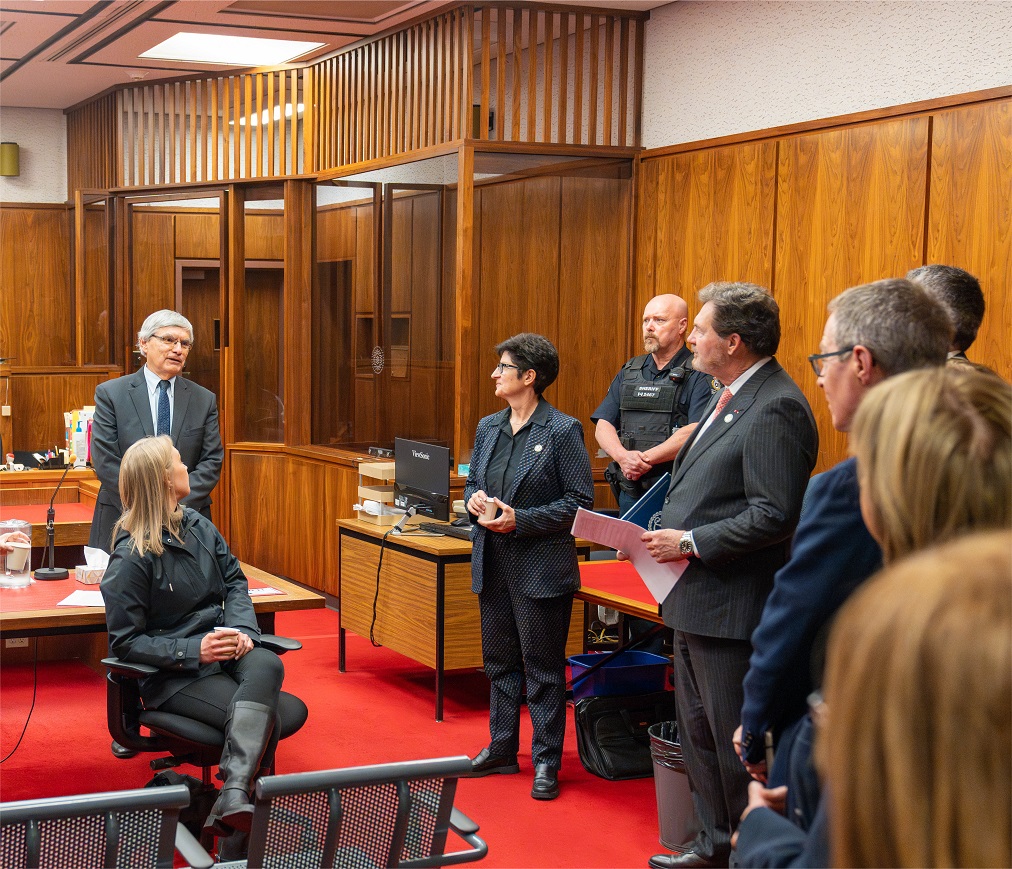
The judges of the Supreme Court of Canada serve Canadians and make important decisions that impact their lives and communities, but not everyone can come to Ottawa to learn about the work of the Court. To mark its 150th anniversary, the Court travelled to five Canadian cities to meet with local communities, share insights about its role, and learn about the realities of people accessing the justice system across the country.
Chief Justice Richard Wagner and his colleagues visited five cities over the course of 2025:
- On February 3-4, Chief Justice Richard Wagner and Justices Andromache Karakatsanis and Nicholas Kasirer visited Victoria, British Columbia.
- On March 10-11, Chief Justice Richard Wagner and Justices Suzanne Côté and Sheilah L. Martin visited Moncton, New Brunswick.
- On September 14-15, Chief Justice Richard Wagner and Justices Nicholas Kasirer and Michelle O’Bonsawin visited Yellowknife, Northwest Territories.
- On October 21-23, Chief Justice Richard Wagner and Justices Mahmud Jamal and Mary T. Moreau visited Sherbrooke, Quebec.
- On November 17-18, Chief Justice Richard Wagner and Justices Suzanne Côté, Malcolm Rowe and Michelle O’Bonsawin visited Thunder Bay, Ontario.
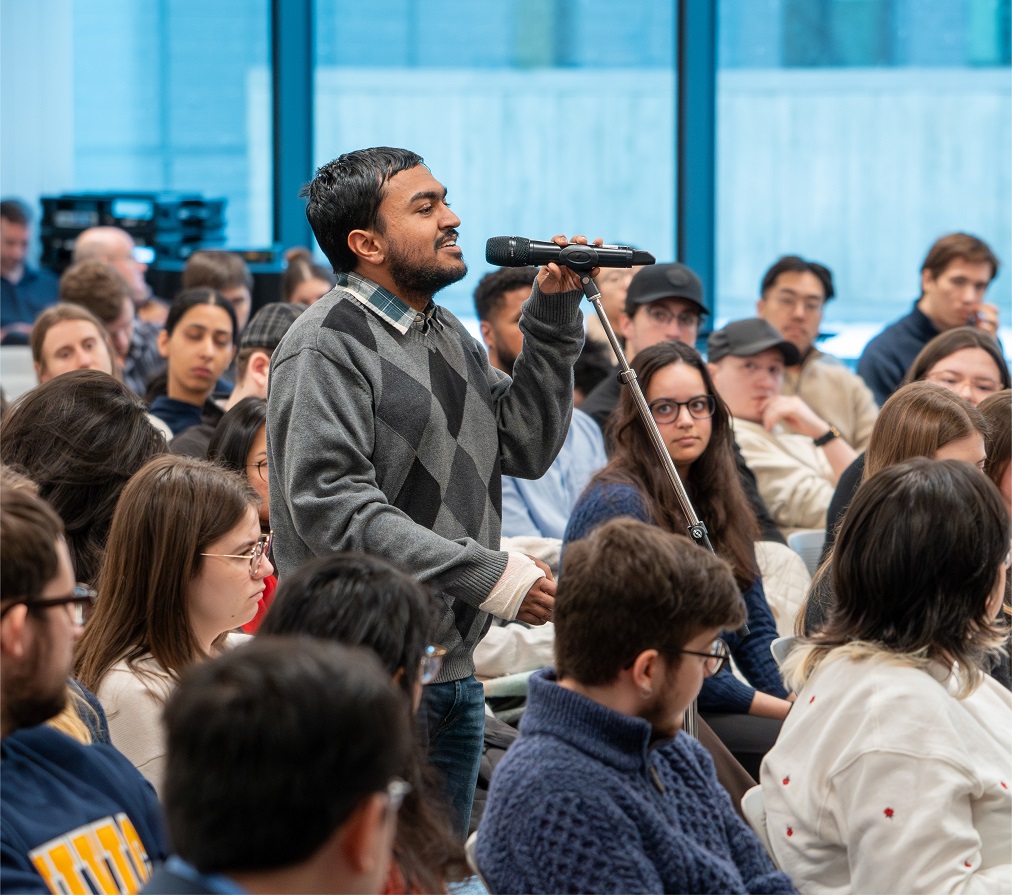
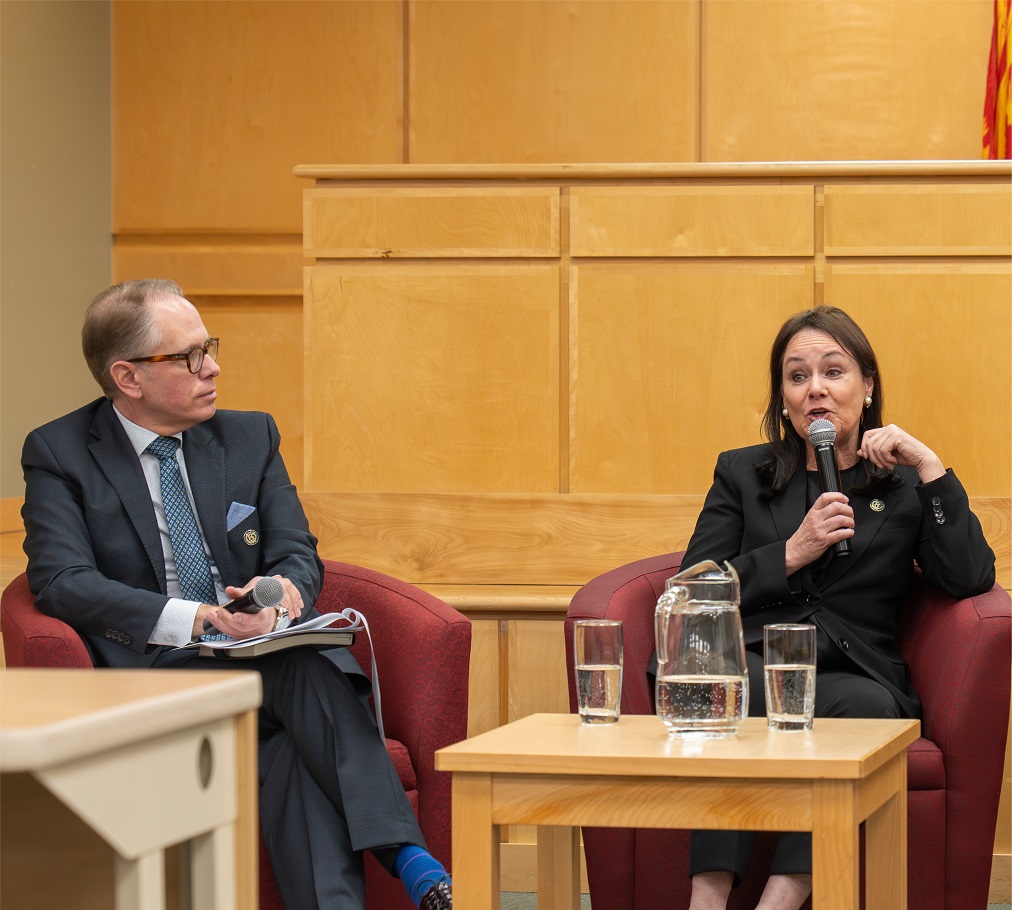
During each visit, local organizing committees put together a program that included a public event called Beyond the bench: a dialogue with Judges of the Supreme Court of Canada.
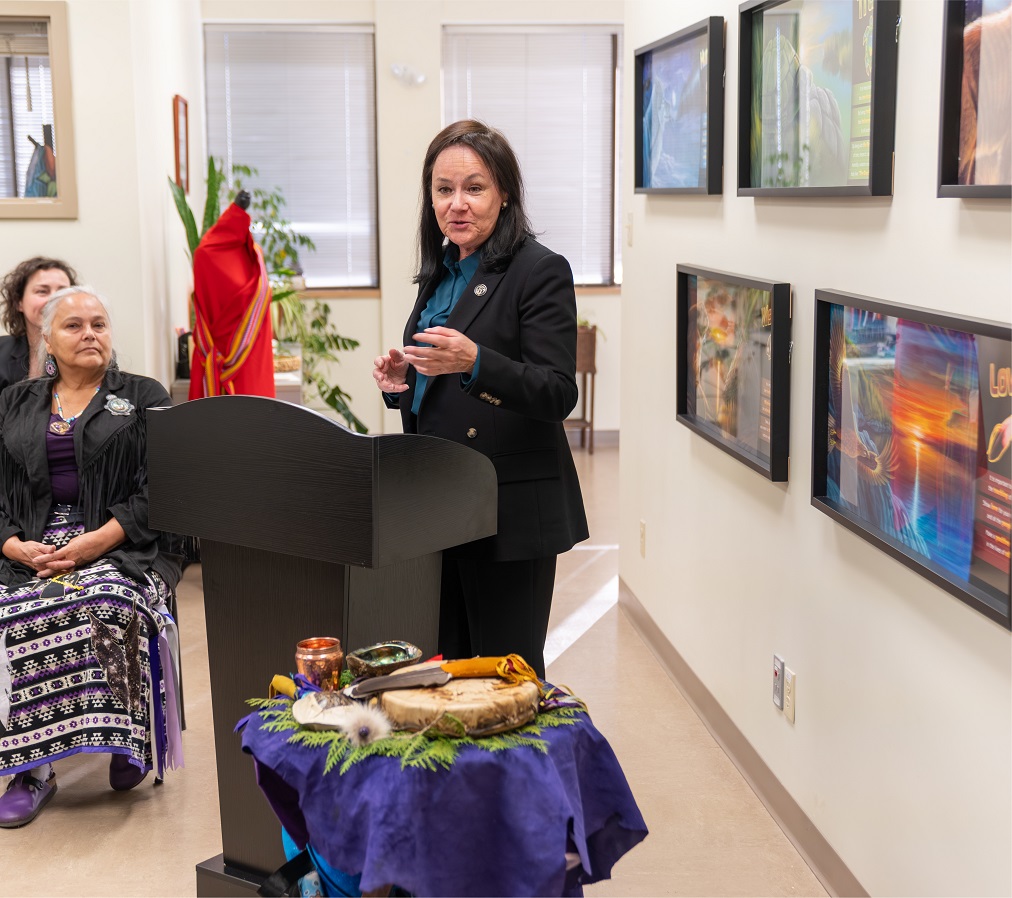
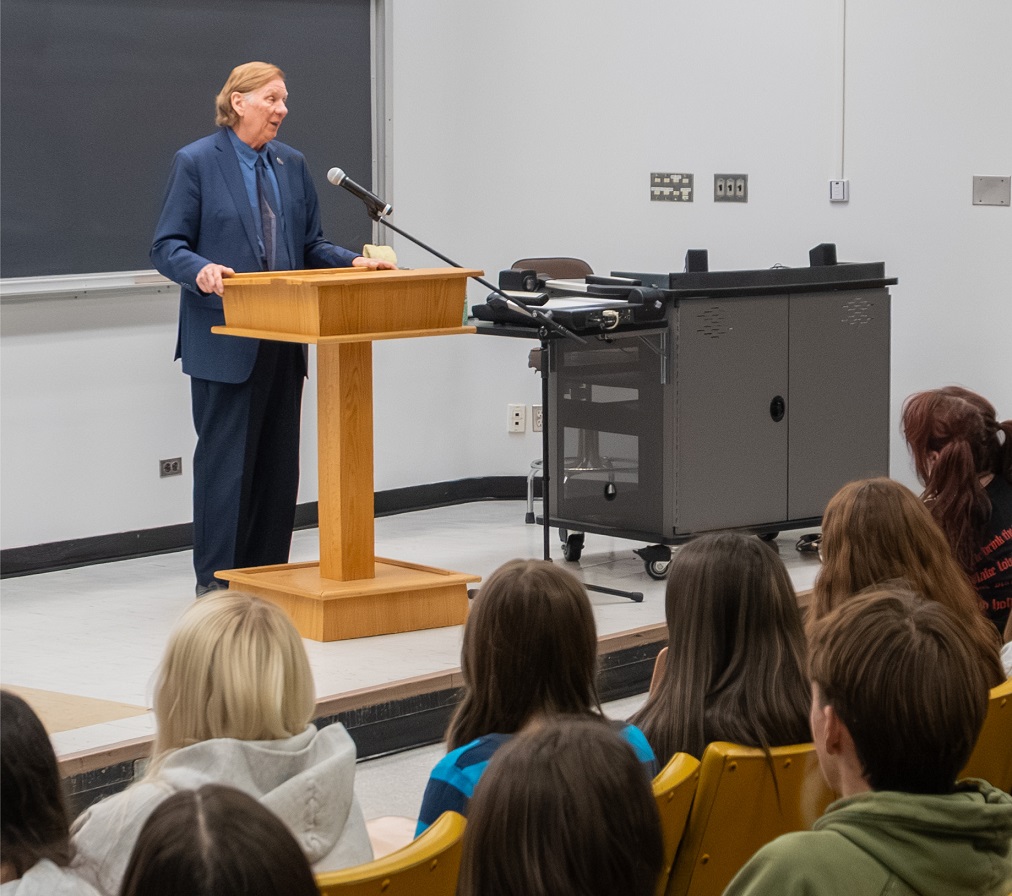
The judges also met with local high school students, university students and faculty, the media, and the local legal community. In addition, they visited specialized courts and learned from local Indigenous leaders. These gatherings allowed the judges to hear a wide range of experiences and connect with many different communities.
Supreme Court of Canada decisions often involve complex constitutional and legal principles. Meeting with Canadians helps make the justice system more accessible and understandable. By explaining their role and processes, the judges reinforce public confidence in the fairness and independence of the Canadian judiciary. It is hard to trust something you do not understand, and cultivating that understanding is an important aspect of their work outside of the courtroom. By engaging directly with Canadians, the judges not only shared the Court’s work, but also gained insights that inform their awareness of the barriers many people face in accessing justice across the country.
“I am very proud of our justice system, and I hope you are too. Every day, in courtrooms across the country, justice is alive and well.”
The Right Honourable Richard Wagner, P.C.
Chief Justice of Canada
Victoria
February 3-4, 2025



Moncton
March 10-11, 2025




Yellowknife
September 14-15, 2025




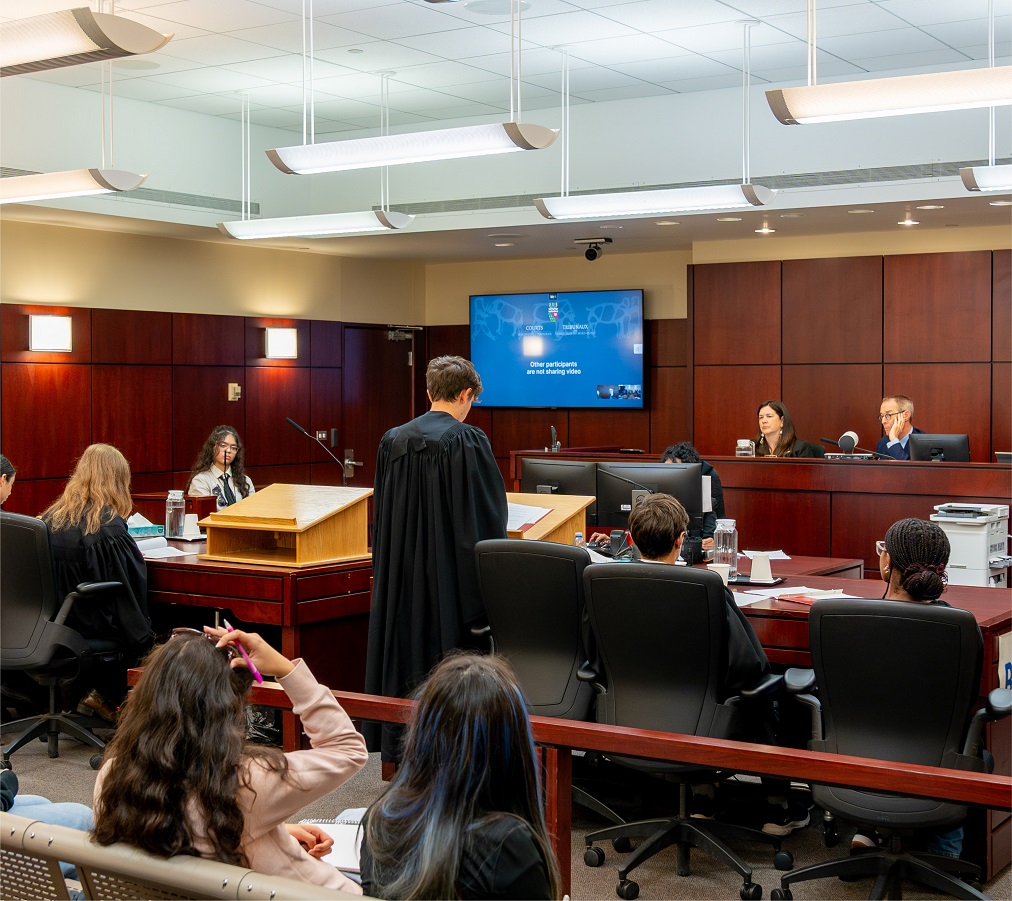
Sherbrooke
October 21-23, 2025
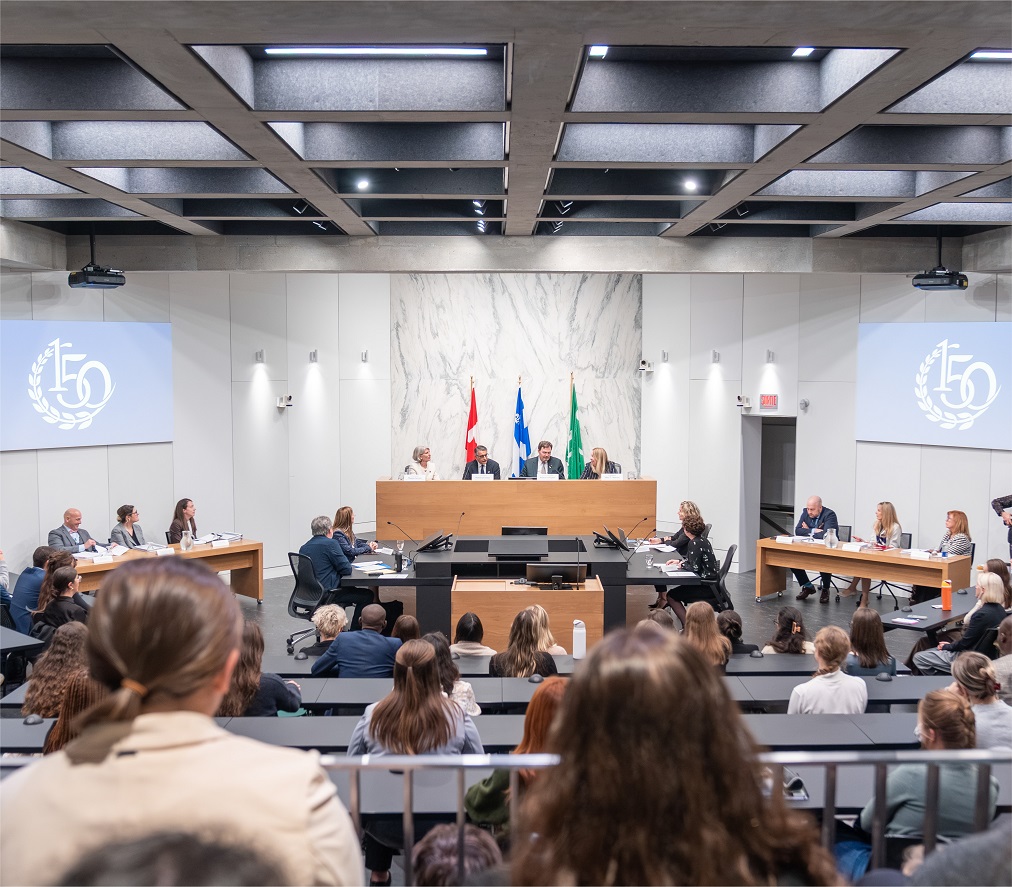




Thunder Bay
November 17-18, 2025



Organizing committees
The Supreme Court of Canada extends its sincere appreciation to the regional organizing committees that supported the planning and delivery of its visits across the country. Comprised of members of the local judiciary, bar associations, law societies, and other partners, these committees played an essential role in ensuring the success of each visit. Their dedication and commitment to public engagement made it possible for the Court to connect meaningfully with communities, fostering a greater understanding of our work.
Victoria
The Honourable Leonard Marchand, the Honourable Peter Willcock, the Honourable Geoffrey Gaul, the Honourable Carmen Rogers, the Honourable Bruce Cohen, the Honourable Lindsay LeBlanc, Dean Freya Kodar, Kerry Simmons, Sarah Klinger, Clare Jennings, and Heidi McBride
Moncton
The Honourable Marc Richard, the Honourable Denise A. LeBlanc, Dean Michael Marin, James E. Lockyer, Jason Alcorn, and Justin Robichaud
Yellowknife
The Honourable Ritu Khullar, the Honourable Shannon Smallwood, the Honourable Annie Piché, the Honourable Jeannie Scott, the Honourable Gary Magee, Keelen Simpson, Jessica Copple, Mark Ishack, John Inglis, Stefanie Laurella, Tyler Vibert, Peter Harte, and Jeff Round
Sherbrooke
The Honourable Manon Savard, the Honourable Claude Villeneuve, the Honourable Catherine Brousseau, Dean Marie-Pierre Robert, Principal Sébastien Lebel-Grenier, Kim Désilets, Stéphanie Côté, Caroline Monette, Sarah Haddon, and Michaël Poutré
Thunder Bay
The Honourable Michael Tulloch, the Honourable William Hourigan, the Honourable Patrick Boucher, the Honourable Dan Newton, the Honourable David Gibson, Scott McCormack, Sarah McLeod, Jennifer Purves, Darrell Mandamin, Rosa Carlino, Claire Littleton, Annette Nadarajah, Jacob Bakan, and Stephanie Ho
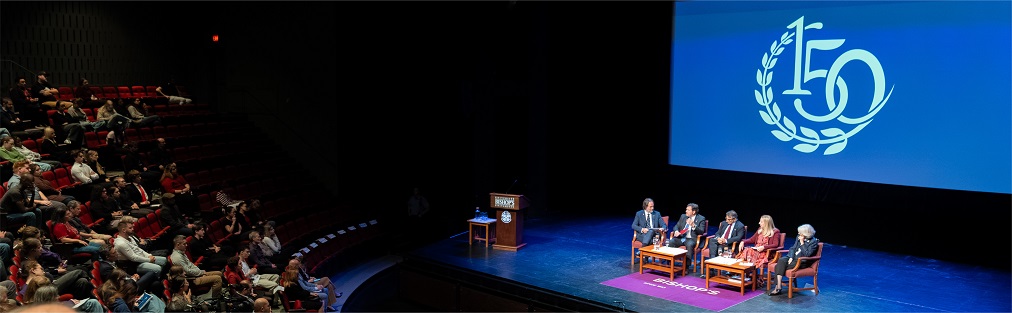
Special exhibit on the Court’s history
On April 7, the Supreme Court of Canada unveiled a special anniversary exhibit in its grand entrance hall, developed in collaboration with the Senate of Canada and Library and Archives Canada. Entitled The Supreme Court at 150, the exhibit traced the Court’s evolution from its establishment in 1875 to today.
Through rare and original documents, visitors explored defining moments in the Court’s history. Highlights included original copies of the 1875 Supreme and Exchequer Court Act, which formally established the institution, as well as the royal proclamation of the Constitution Act, 1982, which included the Canadian Charter of Rights and Freedoms. The Charter sets out the Supreme Court of Canada’s role as guardian of the Constitution.
Beyond documenting institutional milestones, the exhibit provided insight into the practical realities of the Court’s early operations, from establishing a library to procuring furniture for judges’ chambers. Visitors also discovered the Court’s first decisions, which addressed pressing questions of federalism, property rights, and religious freedoms.
By situating these stories within the broader constitutional history of Canada, the exhibit offered a deeper appreciation of the Court’s enduring role in safeguarding justice and the rule of law. The exhibit was also made available virtually, ensuring broad public access to this important page in our history.
We are grateful to the Senate of Canada and Library and Archives Canada for researching and curating this exhibit. Their work ensured the careful selection of historically significant materials, that were installed in a manner that safeguarded these national treasures for generations to come.
Among the special guests to view the exhibit were Their Excellencies the Right Honourable Mary Simon, Governor General of Canada and Mr. Whit Fraser, the Honourable Raymonde Gagné, Speaker of the Senate, Ms. Shaila Anwar, Clerk of the Senate and Clerk of Parliaments, and Ms. Leslie Weir, Librarian and Archivist of Canada.


Legal symposium
A legal symposium was held on April 10 and 11, to coincide with the anniversary of the establishment of the Supreme Court of Canada. Hosted at the Court’s magnificent heritage building, the bilingual symposium gathered justices of the Supreme Court, judges from Canadian and international courts, academics, legal practitioners, students, and journalists.
The symposium was officially launched with words of welcome from the Chief Justice of Canada, the Right Honourable Richard Wagner, and from the Governor General of Canada, Her Excellency the Right Honourable Mary Simon. On the second day of the symposium, five panel discussions covered a variety of topics including the role of apex courts, Indigenous peoples, federalism, private law, and emerging issues. These conversations honoured the traditions that have shaped Canada’s legal system over the years, while embracing the evolution that has kept the Court responsive to the needs of the communities it serves.
The legal symposium was organized with the assistance of the National Judicial Institute.
A focus on the Court’s evolution
The symposium created a valuable forum to exchange ideas on how courts can adapt to evolving challenges. By bringing together diverse perspectives from Canada and abroad, it reinforced our shared commitment to a resilient and responsive justice system. Held during the Court’s 150th anniversary year, it also provided a meaningful occasion to reflect on the Court’s history while looking ahead to its future role in serving Canadians.
“This anniversary is an opportunity to recognize the responsibility the Court bears to act as a guardian of justice, impartiality, and public trust. Each judgment handed down resonates beyond these courtroom walls, supporting the strength of our democracy.”
The Right Honourable Richard Wagner, P.C.
Chief Justice of Canada
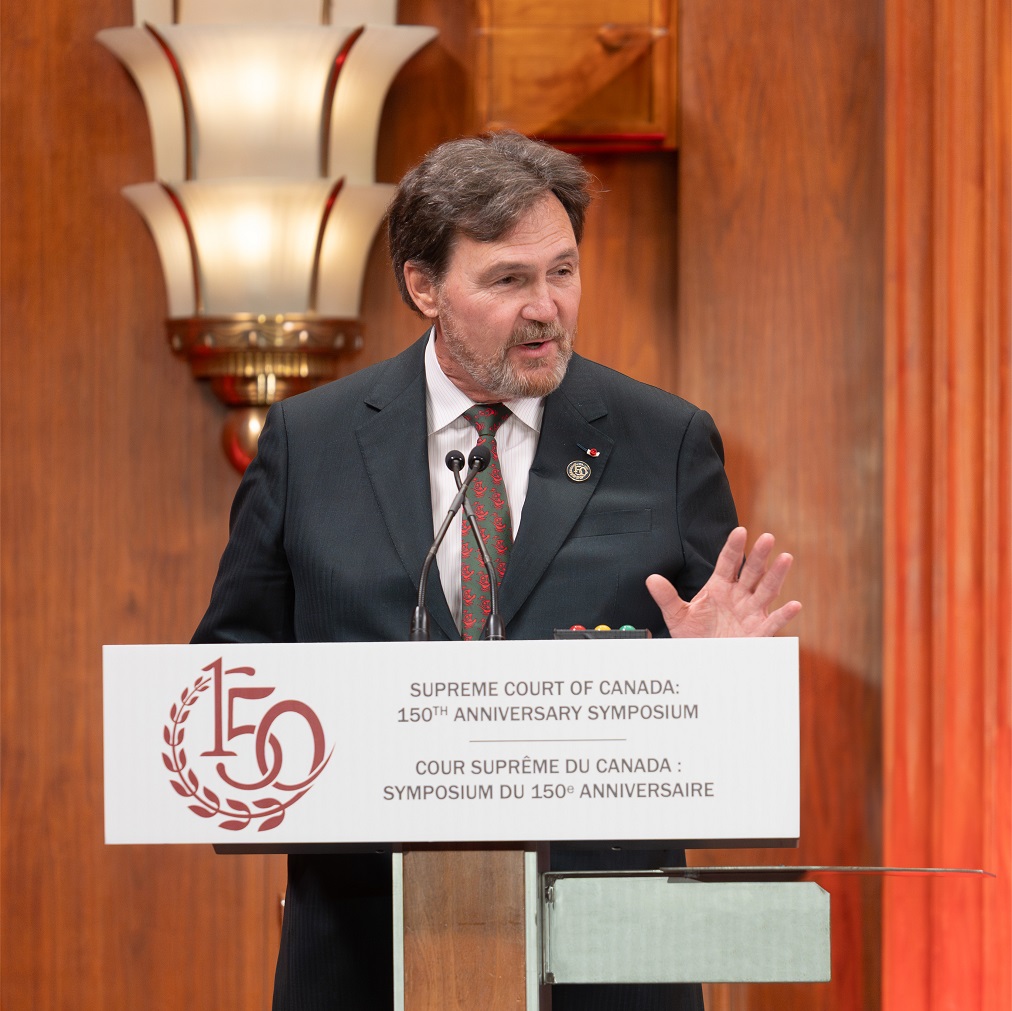
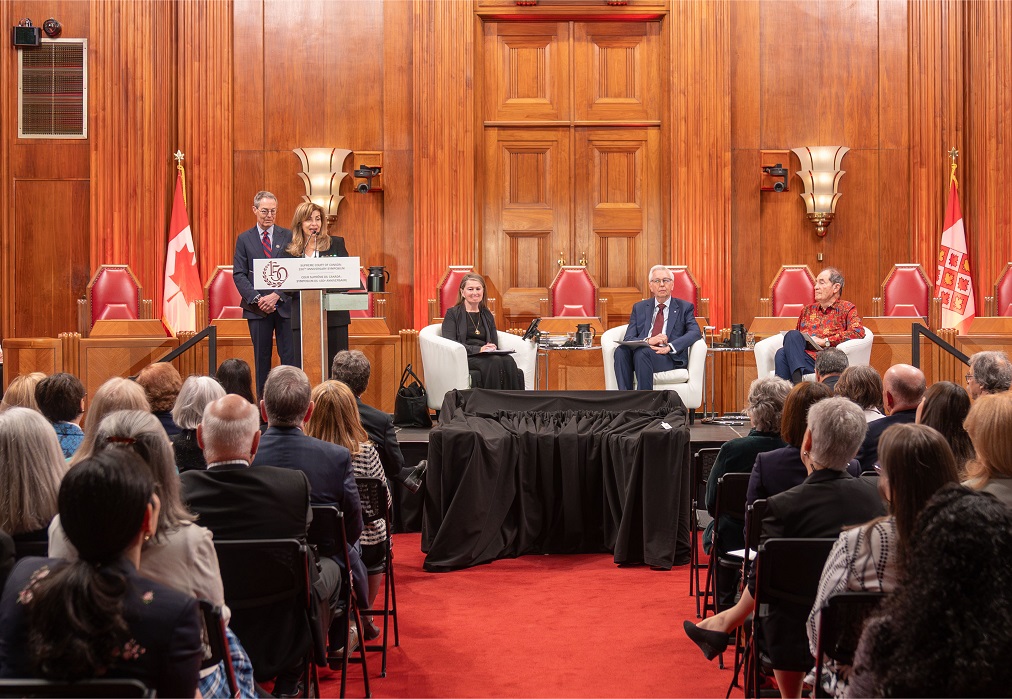

The panels
- The role of an apex court in a constitutional democracy, moderated by the Honourable Georgina R. Jackson, Court of Appeal for Saskatchewan, and featuring two panelists, the Honourable Albie Sachs, retired justice, South African Constitutional Court, and Stephen J. Toope, President and CEO, Canadian Institute for Advanced Research.
- Indigenous peoples and apex courts, moderated by the Honourable Sébastien Grammond, Federal Court, and featuring two panelists, the Honourable Joe Williams, Supreme Court of New Zealand, and Professor Naiomi Metallic, Assistant Professor, Chancellor in Aboriginal Law and Policy, Dalhousie University, Schulich School of Law.
- Federalism at the Supreme Court of Canada, moderated by Dean Marie-Eve Sylvestre, Dean and Full Professor, University of Ottawa, Faculty of Law (Civil Law Section), and featuring two panelists, the Honourable Yves de Montigny, Chief Justice, Federal Court of Appeal, and Professor Jeremy Webber, University of Victoria, Faculty of Law.
- Dialogues on private law: bijuralism at the Supreme Court of Canada, moderated by Professor Shauna Van Praagh, President, Law Commission of Canada, featuring two panelists, the Honourable Justice Audrey Boctor, Superior Court of Québec, and Professor Lionel Smith, Professor of Comparative Law, University of Oxford, Faculty of Law.
- Emerging issues in a cosmopolitan legal world, moderated by Hélène Buzzetti, political columnist, Les Coops de l’information, and featuring two panelists, the Honourable Donal O’Donnell, Chief Justice, Supreme Court of Ireland, and the Honourable Louise Arbour, retired Justice of the Supreme Court of Canada, Senior Counsel, Borden Ladner Gervais LLP.
Essay contest
As part of its 150th anniversary, the Supreme Court of Canada invited law students across the country to take part in a national essay writing competition. Participants were asked to write about a landmark Supreme Court decision, exploring its impact on Canadian society and its future implications for the development of Canadian law.
Congratulations to the winners, who were invited to attend the legal symposium in Ottawa on April 10-11, organized in partnership with the National Judicial Institute. Excerpts from their submissions can be found below.
Anne Lin Arghirescu
Faculty of Law, McGill University

The decision [in Reference re An Act respecting First Nations, Inuit and Métis children, youth and families, 2024 SCC 5] is much more interesting for its novel treatment of the section 91(24) federal power over “Indians and lands reserved for Indians”. The SCC ties section 91(24) to the principles of honour of the Crown and reconciliation. By treating the recognition of Aboriginal self-government in the Act as binding on Parliament, the Court effectively builds a floor to the section 91(24) power below which the federal government cannot legislate.
Sandrine Couture
Faculty of Law, Université de Montréal

The repercussions of [CCH Canadian Ltd. v. Law Society of Upper Canada, 2004 SCC 13] can therefore be summarised as follows: this decision put an end to the jurisprudential uncertainty surrounding the qualification of the criterion of originality in copyright law, and thus became the benchmark for the analysis of this concept. However, this 2004 decision has particular implications for the current technological context. In addition, it will undoubtedly have other effects depending on technological developments, particularly in the field of artificial intelligence.
Art contest
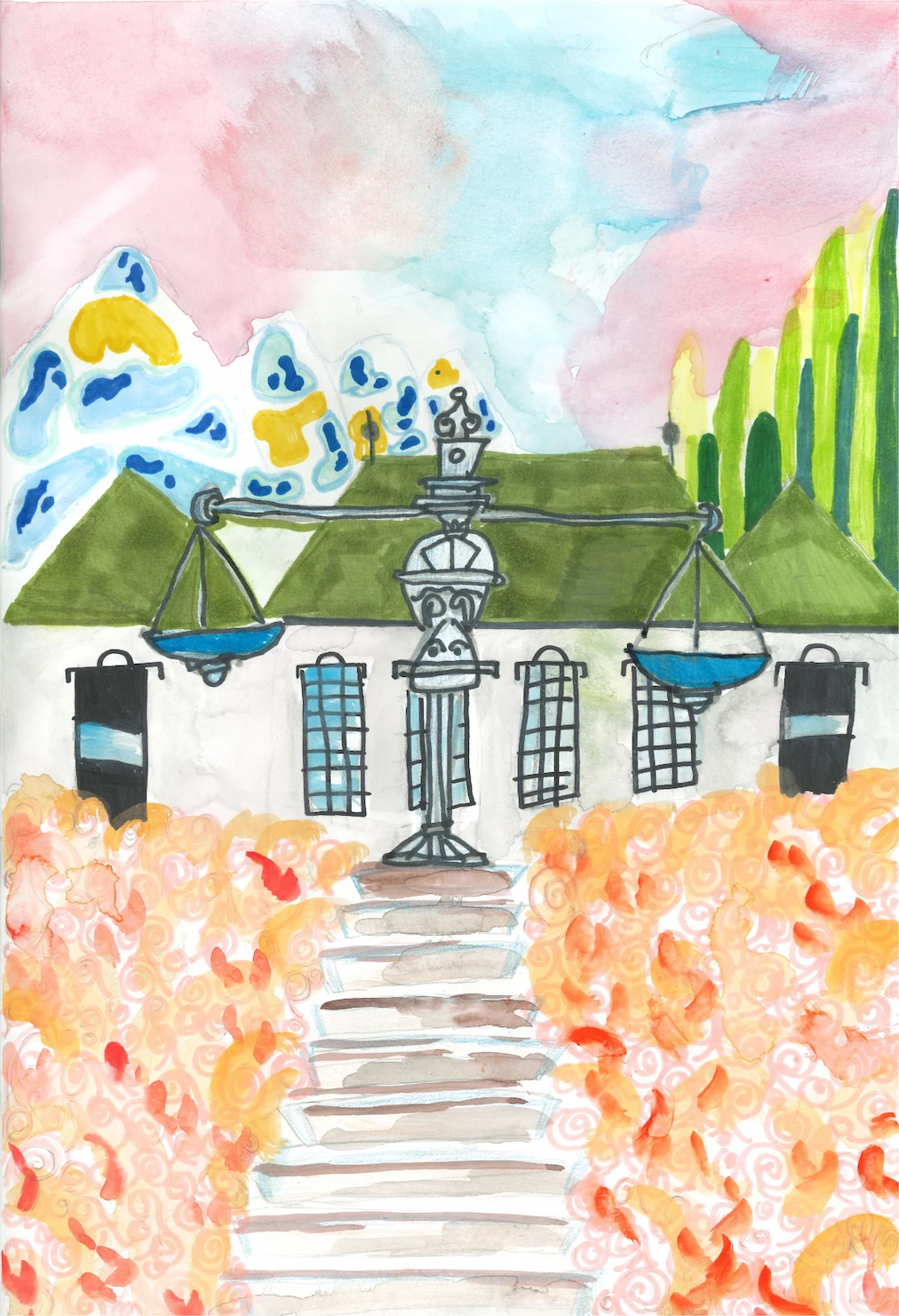
To mark this milestone anniversary, the Supreme Court of Canada invited young people across the country to showcase their creativity by submitting original artwork. Open to participants aged 5 to 17, the contest encouraged reflection on the Court’s history and role in Canadian society through drawing, painting, or digital art.
Congratulations to the winners: Caylan Situ, Hanna Lemus, and Zoey Verhovsek, whose artwork will be on display in the grand entrance hall in 2025 and 2026.


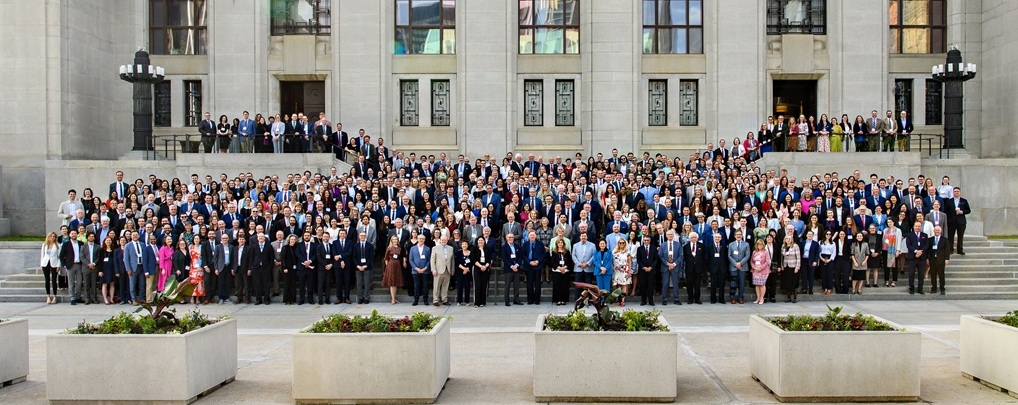
Law clerk reunion
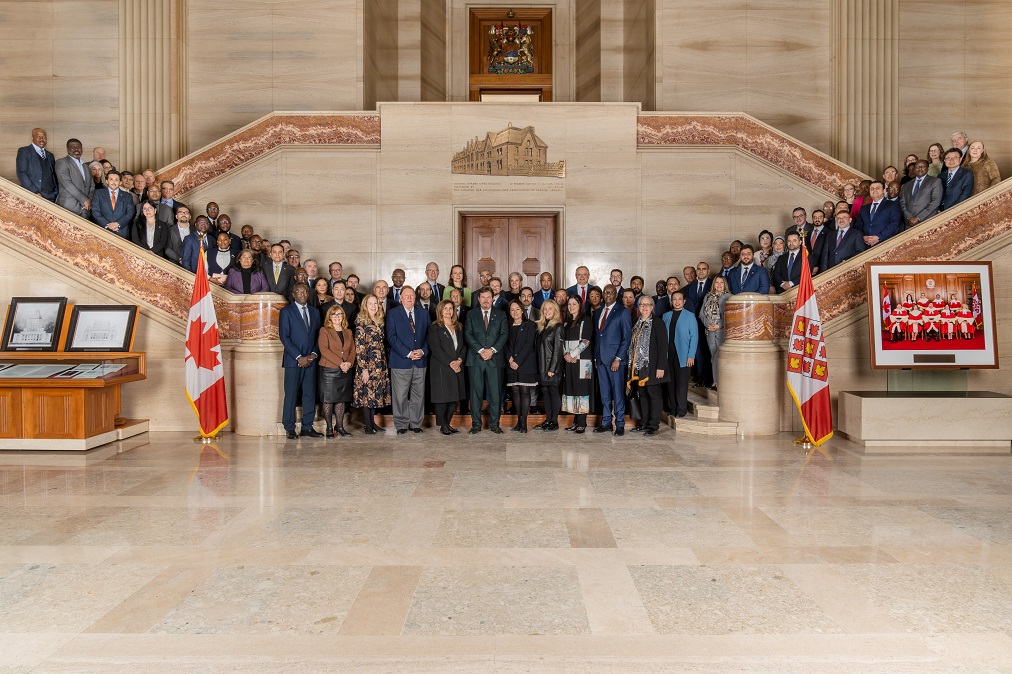
From June 13 to 15, the Supreme Court of Canada welcomed back generations of its former law clerks for a special reunion in Ottawa. The gathering brought together clerks, judges, registrars, and executive legal officers who worked at the Court from the launch of the law clerk program in 1967 through to the present day.
The reunion provided a rare opportunity for colleagues across nearly six decades to reconnect, reflect on their experiences at the Court, and celebrate the lasting contributions of the clerkship program. Attendees shared stories of their time assisting judges, exchanged perspectives on the evolution of Canadian jurisprudence, and renewed friendships formed in the unique environment of the Court.
The event underscored the vital role that clerks have played in supporting the Court’s work over the years and highlighted the strong professional community that continues to thrive well beyond their service.


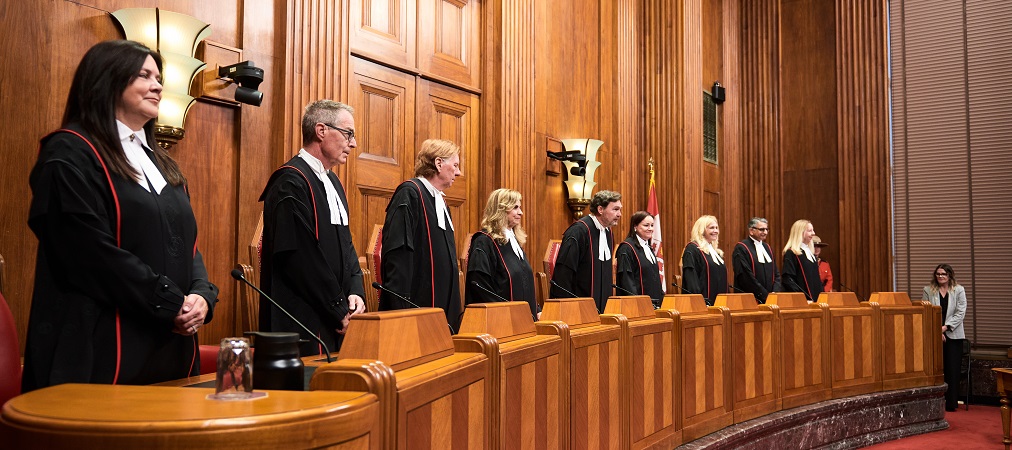
Opening of the judicial year
On October 6, the Supreme Court of Canada marked its 150th anniversary with a ceremonial opening of the judicial year. Held in Ottawa and broadcast live, the event provided an historic opportunity for Canadians to participate in this renewed tradition.
Ceremonial openings of the courts serve as an occasion for members of the judiciary, the legal profession, and the broader community to come together. After welcome remarks from Chief Justice Richard Wagner, the audience heard from:
- The Honourable Sean Fraser, Minister of Justice and Attorney General of Canada
- Dean Kristen Boon, President of the Council of Canadian Law Deans
- Ms. Bianca Kratt, President of the Canadian Bar Association
- Ms. Teresa Donnelly, President of the Federation of Law Societies of Canada
- Ms. Hilary Book, President of The Advocates’ Society
The 2025 ceremony was of particular significance, as it was the first such occasion at the Supreme Court of Canada since the mid-1980s.


Circulation coin
On April 8, the Royal Canadian Mint issued a $1 commemorative coin to mark the 150th anniversary of the Supreme Court of Canada.
The coin, created by Ontario artist Silvia Pecota, shows the front of the Court building, symbolizing its centrality to Canada’s justice system. The steps are overlaid with the Supreme Court’s 150th anniversary logo, designed by Court employee Hazel Forbes, which represents both history and continuity. The opposite side of the coin features the effigy of His Majesty King Charles III, designed by Steven Rosati.
At the unveiling, Chief Justice Richard Wagner expressed pride that the coin will invite Canadians to reflect on the Court’s role as guardian of our Constitution and the Canadian Charter of Rights and Freedoms, while Mint President Marie Lemay highlighted its significance in celebrating Canada’s democratic values.
The commemorative coin serves as an important reminder of the Court’s contributions over the past 150 years and will be circulated across the country for years to come.



In the heart of the Capital
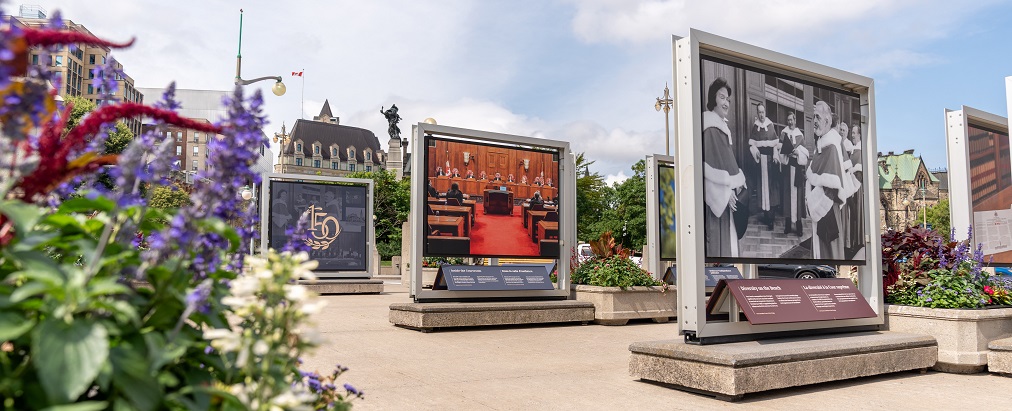
The Supreme Court of Canada partnered with the Department of Canadian Heritage to mark its 150th anniversary with a series of installations across Ottawa. These initiatives invited visitors and residents to learn more about the Court’s history and its role in shaping the country’s legal landscape.
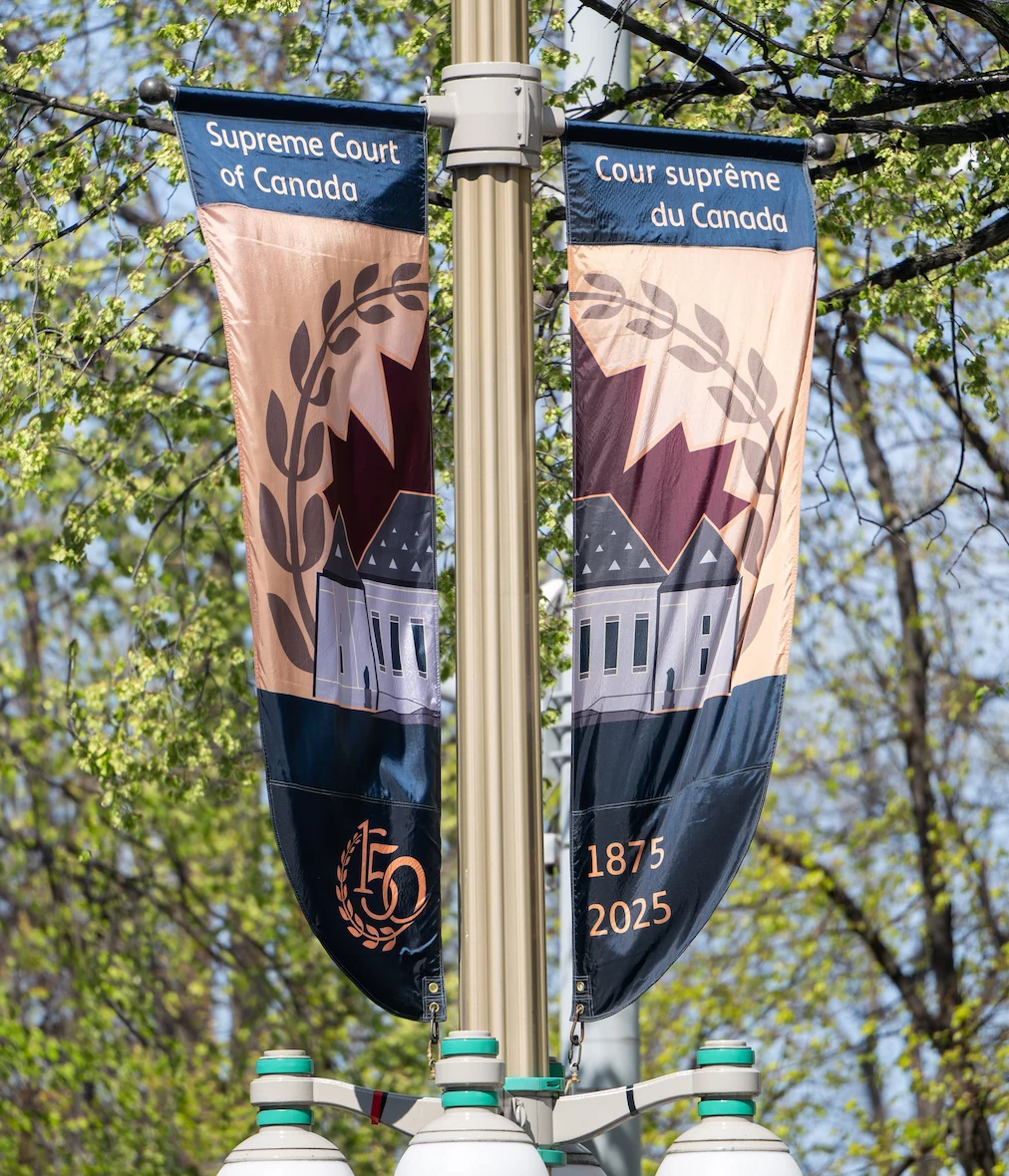
This partnership extended the anniversary beyond the Court’s walls, inviting the public to encounter its story in the heart of the capital. A large-scale photo exhibit on Plaza Bridge highlighted landmark moments from the Court’s past, offering passersby a visual narrative of its evolution. Along Confederation Boulevard, commemorative banners celebrated the institution’s enduring contribution to Canadian society, creating a visible reminder of the Court’s place within our country’s democracy.
These installations animated Ottawa’s downtown core, reaching Canadians and international visitors alike. By bringing the Court’s history into shared public spaces, the anniversary fostered greater awareness of its role in upholding justice and the rule of law.
Outreach and education
While the Supreme Court of Canada’s primary role is to hear and decide cases of public importance, outreach and education remain essential to our work. These efforts are not separate from our judicial responsibilities. Rather, they are fundamental to maintaining a strong, transparent, and trusted justice system.
Public confidence in the Court is crucial to its legitimacy. The authority of its decisions rests on the trust of the Canadian public. When Canadians understand how the Court works and see it as fair and independent, they are more likely to accept its decisions, even if they disagree with the outcome. Outreach helps foster that trust by making the Court more accessible, visible, and understandable to the people it serves.
Educational initiatives — including school visits, lectures, and plain-language explanations of decisions — also support access to justice. By helping Canadians better understand the legal system, we empower individuals to engage with their rights and responsibilities.
On the international stage, our outreach allows us to contribute to the global development of the rule of law. Sharing judicial knowledge with other countries reinforces the importance of independent courts worldwide.
Outreach also provides our judges with valuable opportunities to learn from their cohorts around the world and bring rich, comparative perspectives that enhance judicial reasoning and court administration. All of this is done with careful balance. Outreach and education efforts are planned around the Court’s hearing schedule, and do not compromise the time or attention devoted to decision-making.
In a democracy, courts must not only be fair, they must be seen to be fair. Outreach helps ensure that principle remains true.
“No apex court in the world has the monopoly of wisdom and knowledge. It is more relevant than ever to learn from other jurisdictions about their best practices and share ours. This helps promote a strong and stable democracy within Canada and around the world.”
The Right Honourable Richard Wagner, P.C.
Chief Justice of Canada








Statistics
Statistical summary
In each Year in Review, the Supreme Court of Canada publishes a statistical summary of cases filed, heard, and decided over the preceding year. This report serves as a valuable reference tool for media, researchers, and the public, offering a quantitative view of the Court’s caseload.
This information is for the 2025 calendar year (January 1 to December 31). It is worth noting that a case can extend from one calendar year into the next. This means that:
- A leave application filed in one year may be submitted or decided the following year;
- A leave application granted in one year may be heard the following year; and
- A judgment may be rendered in a different calendar year from the hearing.
For example, most appeals heard in the fall of one year are decided in the winter or spring of the following year. In addition, appeals with issues in common may be decided in the same judgment, even if the Court hears them separately.
Caseload
In 2025, the Court received 517 applications for leave (or permission to appeal) and 18 notices of appeal as of right. Most of the applications for leave to appeal were filed by lawyers on behalf of their clients, but 37% were filed by self-represented litigants, a slightly higher percentage than in 2024 (31%).
There are three numbers that are important when looking at applications for leave to appeal:
- First, there is the number of leave applications filed, 517 in 2025.
- Second, there is the number of leave applications that are submitted to the judges as being complete for decision. In 2025, that number was 474. These two numbers are different because leave applications filed in one year may not be completed by the parties or ready for decision by the judges until the next year.
- Third, there is the number of leave applications that are granted. The Court grants leave to appeal when the judges are of the opinion that the proposed appeal meets the test of public importance as set out in section 40 of the Supreme Court Act. Of the 474 leave applications submitted to the Court in 2025, 30 of those were granted. The Court does not give reasons for its decisions on leave applications.
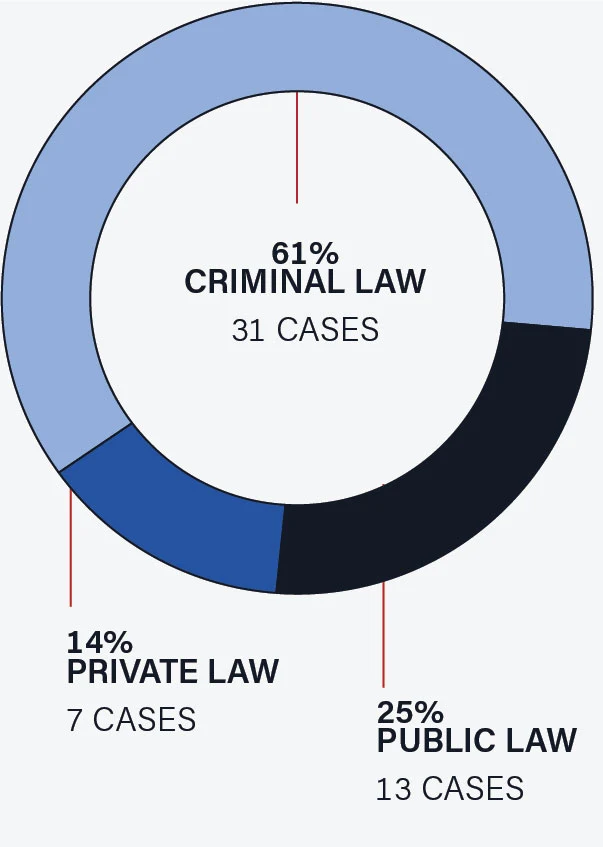
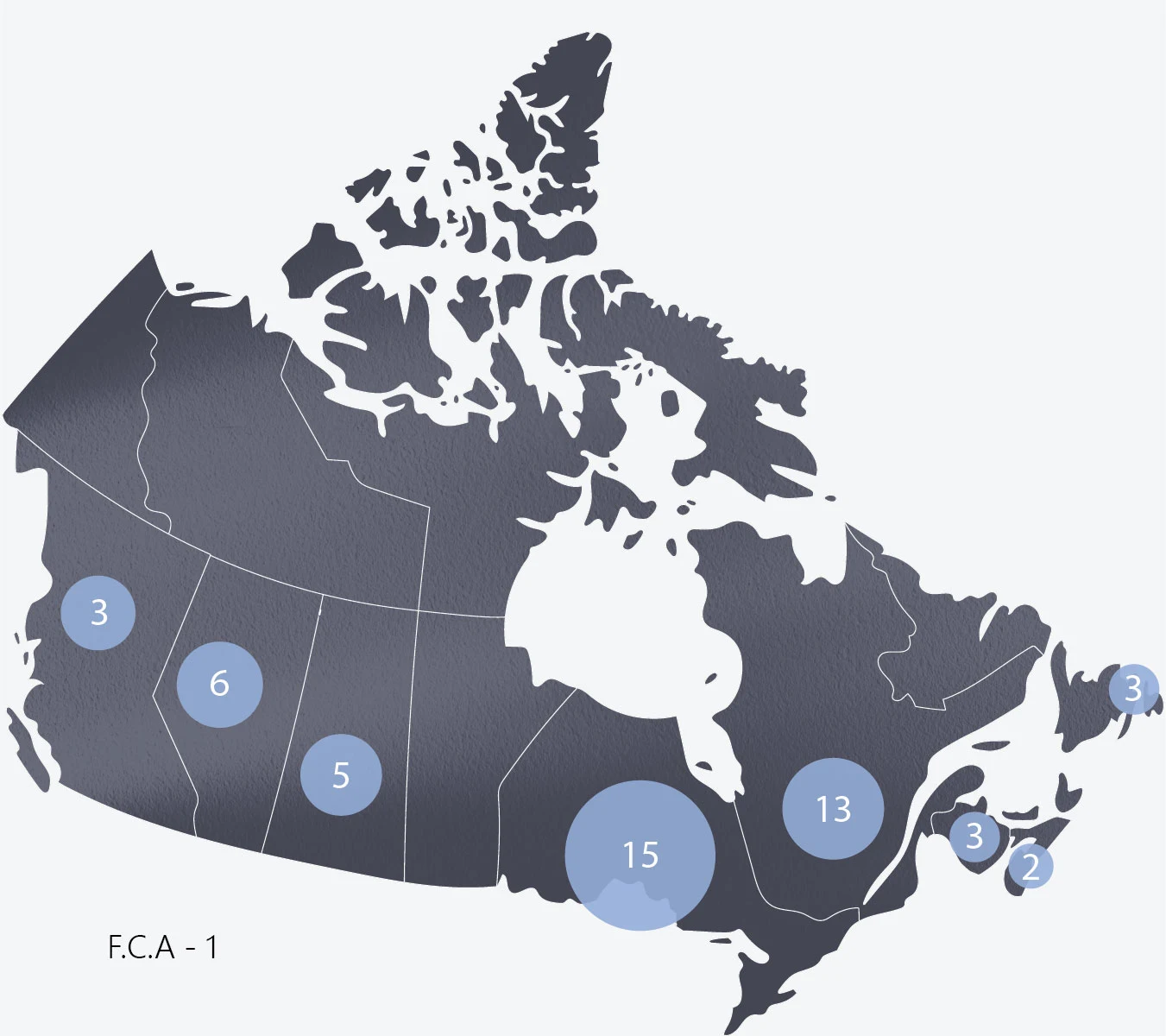
The Court heard 51 appeals in 2025: 31 between January and May and 20 between October and December. As operations continue to return to normal, the Court expects to hear even more cases in 2026.
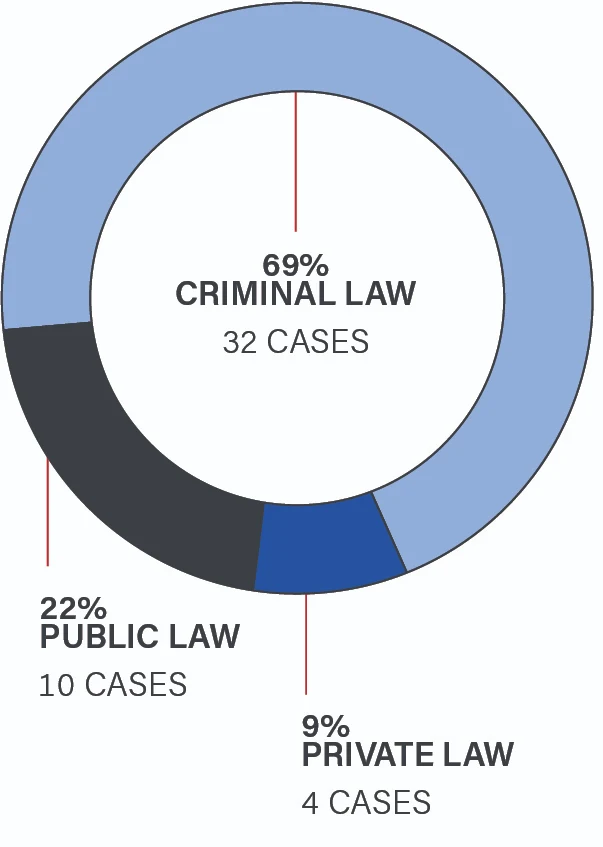
In 2025, the Court rendered 46 judgments, 43% of which were unanimous. The average time between the hearing of an appeal and the judgment was 5.1 months.
Definitions
- Leave application / application for leave to appeal: the documents filed to ask permission for an appeal to be heard.
- Granted (leave application): when the Court gives permission for an appeal to be heard.
- Dismissed (leave application): when the Court does not give permission for an appeal to go forward.
- Allowed (appeal): when the Court overturns a lower-court decision.
- Dismissed (appeal): when the Court agrees with the lower-court decision.
- Decision: the final judgment that ends the appeal; it can be given orally (from the bench) or through written reasons (reserved). Once in a while, a decision from the bench will be followed by written reasons later.
Cases filed
| 2016 | 2017 | 2018 | 2019 | 2020 | 2021 | 2022 | 2023 | 2024 | 2025 | |
|---|---|---|---|---|---|---|---|---|---|---|
| Notices of appeal as of right filed | 15 | 17 | 26 | 25 | 25 | 21 | 23 | 10 | 17 | 18 |
| Applications for leave to appeal filed | 577 | 526 | 531 | 534 | 481 | 492 | 486 | 523 | 526 | 517 |
Applications for leave
| 2016 | 2017 | 2018 | 2019 | 2020 | 2021 | 2022 | 2023 | 2024 | 2025 | |
|---|---|---|---|---|---|---|---|---|---|---|
| Applications for leave submitted to the Court | 598 | 492 | 484 | 552 | 483 | 430 | 451 | 563 | 534 | 474 |
| Granted (pending2) | 50 | 50 | 42 | 36 | 34 | 34 | 31 | 34 | 35 (2) | 30 (29) |
| Percentage granted | 8 | 10 | 9 | 7 | 7 | 8 | 7 | 6 | 7 | 6 |
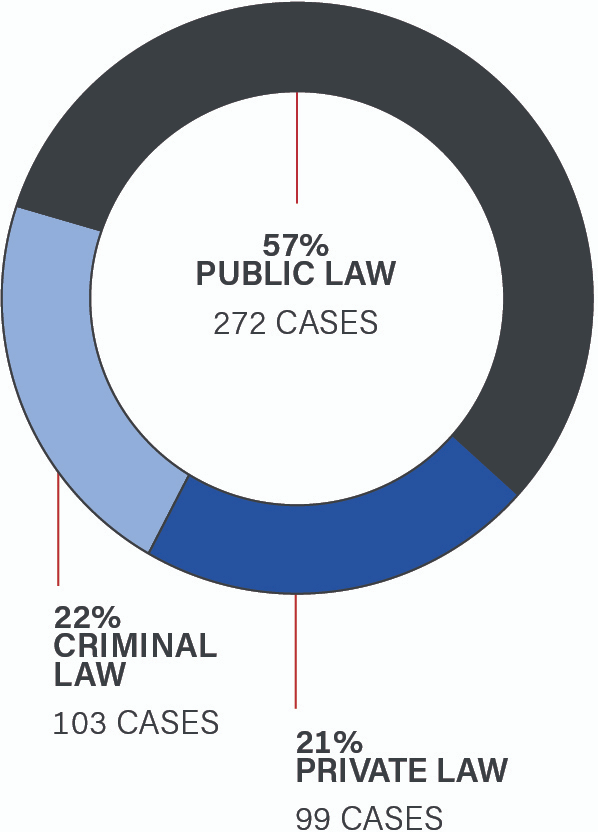
Applications for leave submitted to the Court by category
Definitions
- Public law is about the relationship between individuals and the state. It explains when and how the state can make decisions, enforce laws, and exercise its powers. It includes criminal, constitutional, and administrative matters.
- A criminal matter arises when a person is accused of breaking a law that sets out offences and penalties, such as the Criminal Code or the Controlled Drugs and Substances Act.
- Private law deals with disputes between individuals or organizations, for example family disputes, disagreements over contracts, or claims of defamation.
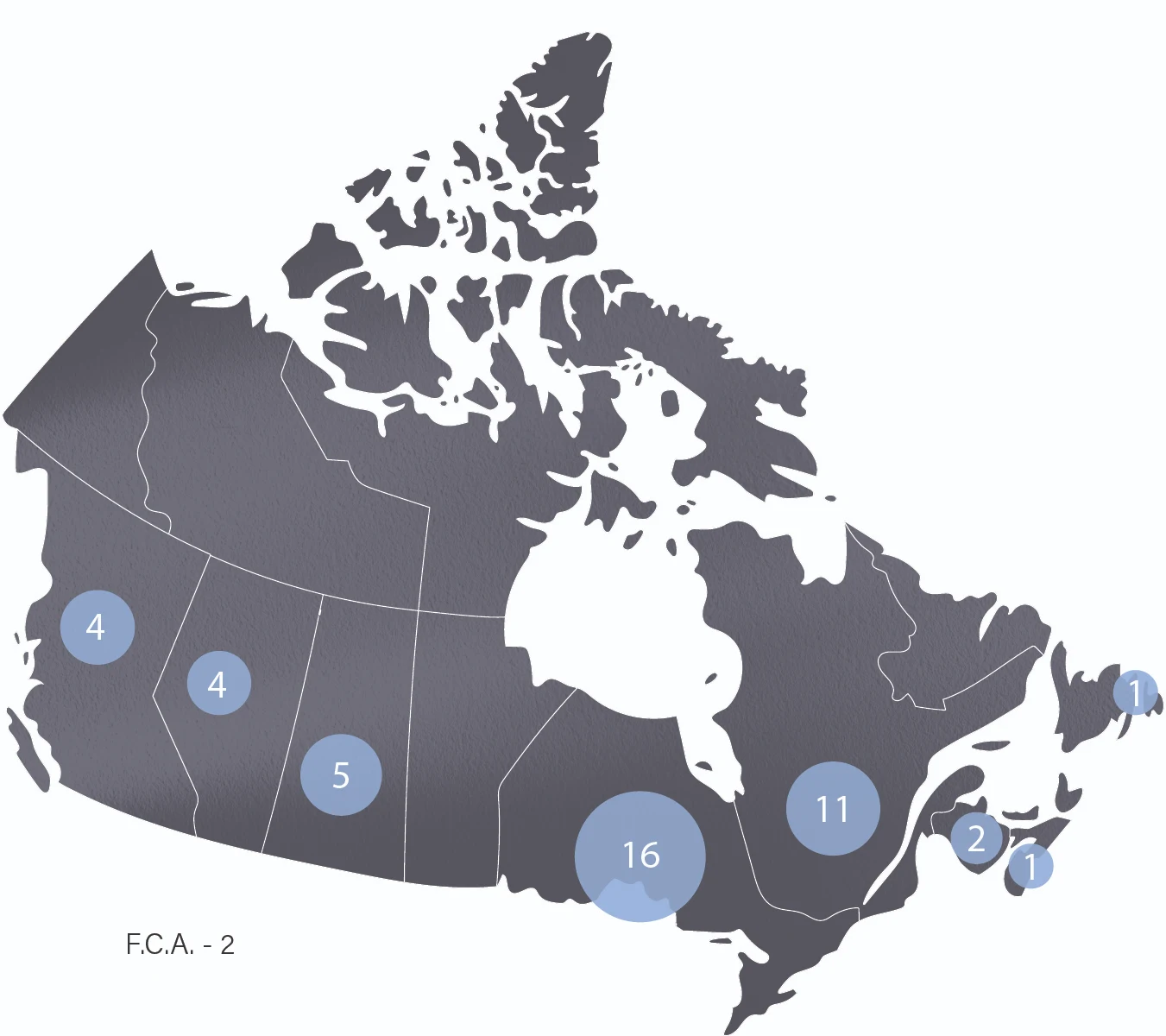
Cases filed by origin
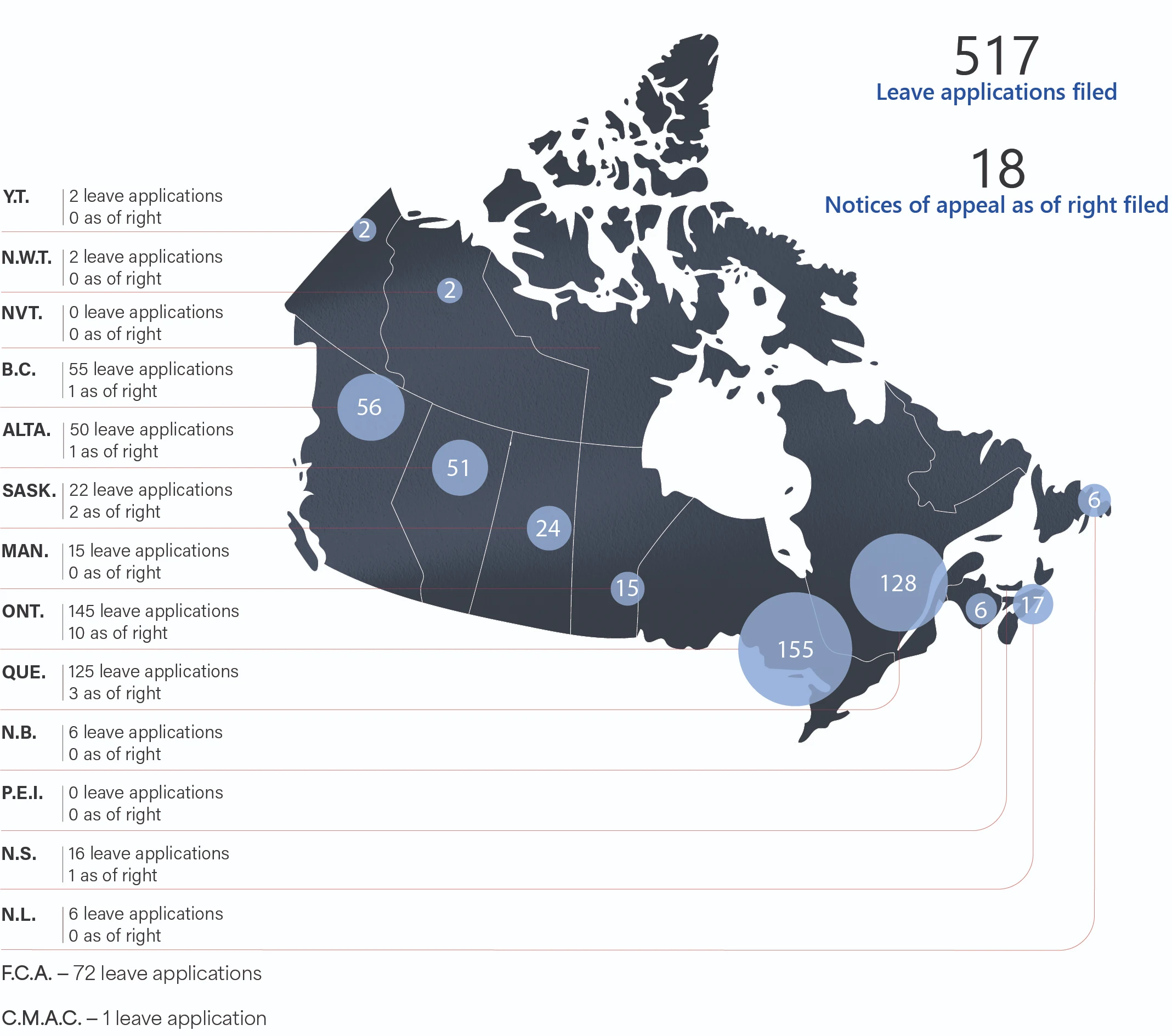
of applications for leave were filed by self-represented litigants, or 191 cases.
Appeals heard
| 2016 | 2017 | 2018 | 2019 | 2020 | 2021 | 2022 | 2023 | 2024 | 2025 | |
|---|---|---|---|---|---|---|---|---|---|---|
| Total number | 63 | 66 | 66 | 69 | 41 | 58 | 52 | 49 | 39 | 51 |
| As of right | 15 | 17 | 21 | 24 | 19 | 26 | 19 | 15 | 11 | 17 |
| By leave | 48 | 49 | 45 | 45 | 22 | 32 | 33 | 34 | 28 | 34 |
| Hearing days | 53 | 60 | 59 | 58 | 35 | 58 | 48 | 46 | 40 | 55 |
Appeals heard by category
Appeals heard by origin
Appeal judgments
| 2016 | 2017 | 2018 | 2019 | 2020 | 2021 | 2022 | 2023 | 2024 | 2025 | |
|---|---|---|---|---|---|---|---|---|---|---|
| Total number | 57 | 67 | 64 | 72 | 45 | 59 | 53 | 36 | 50 | 46 |
| Delivered from the bench | 13 | 19 | 20 | 25 | 17 | 22 | 17 | 10 | 8 | 16 |
| Delivered after being reserved | 44 | 48 | 44 | 47 | 28 | 37 | 36 | 26 | 42 | 30 |
| Appeals allowed | 29 | 28 | 33 | 39 | 24 | 22 | 20 | 18 | 20 | 17 |
| Appeals dismissed | 28 | 39 | 31 | 33 | 21 | 37 | 33 | 18 | 30 | 29 |
| Unanimous | 35 | 36 | 31 | 30 | 22 | 27 | 29 | 21 | 19 | 20 |
| Split | 22 | 31 | 33 | 42 | 23 | 32 | 24 | 15 | 31 | 26 |
| Percentage of unanimous judgments | 61 | 54 | 48 | 42 | 49 | 46 | 55 | 58 | 38 | 43 |
| Appeals standing for judgment at the end of each year | 24 | 25 | 25 | 26 | 20 | 21 | 16 | 30 | 19 | 24 |
| 2016 | 2017 | 2018 | 2019 | 2020 | 2021 | 2022 | 2023 | 2024 | 2025 | |
|---|---|---|---|---|---|---|---|---|---|---|
| Between filing of application for leave and decision on application for leave | 4.1 | 4.0 | 5.8 | 4.3 | 3.6 | 3.0 | 3.9 | 4.6 | 4.3 | 4.4 |
| Between date leave granted (or date notice of appeal as of right filed) and hearing | 7.5 | 7.4 | 6.7 | 6.3 | 8.6 | 8.2 | 8.6 | 9.9 | 9.4 | 9.1 |
| Between hearing and judgment | 4.8 | 4.6 | 4.8 | 5.3 | 5.4 | 4.2 | 4.6 | 5.5 | 6.3 | 5.1 |
Appeal judgments by category
Appeal judgments by origin
Connect with the Court
There are many ways to interact with the Supreme Court of Canada, to learn about its work, and discover what its decisions mean for you.
- Follow the Court on social media: Find out about Court news as soon as it happens and learn more about our country’s final court of appeal.
- Contact the Registry: The Registry is the point of contact between the Court and parties to a case. Registry staff can help you understand how to file documents or prepare to appear before the Court. Each year, the Registry responds to thousands of inquiries from counsel, self-represented litigants, and the public.
- Find information about a case: Search the Court docket to see the status of a case and find links to relevant documents, including factums, counsel sheets, and judgments. For more complex inquiries, contact our Records Centre for help.
- Take a tour: Learn about the Court from our tour guides, in person or remotely! You can visit the Supreme Court building in Ottawa or take a remote tour online. Tours are offered year-round in both English and French and are suitable for individuals, groups, and schools.
- Attend a hearing: Most hearings are open to the public, except when a sealing order requires that a proceeding be held in a closed session (in camera). Hearings are held from fall to spring. Consult the hearing schedule and reserve your seat by contacting the Registry.
- Watch hearings online: You can view hearings both live and on-demand on the Court’s website. Whether you choose to follow proceedings in person, online, or on television, simultaneous interpretation is available in both English and French.
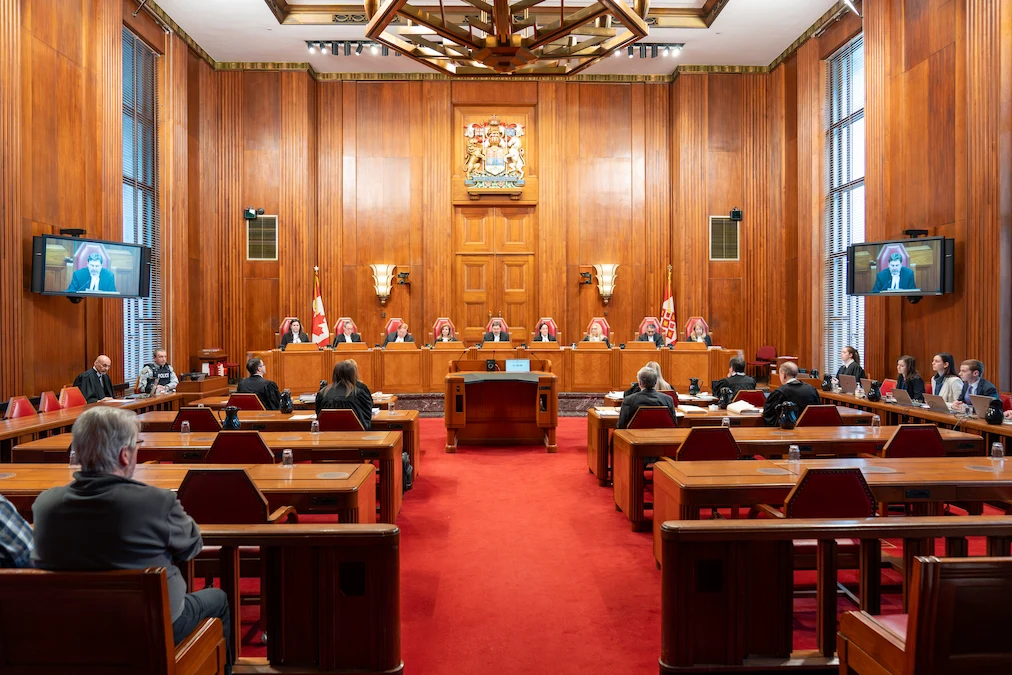

Photo credits
All photos (except those listed below): Supreme Court of Canada collection
- Portrait of Justice Karakatsanis: Jessica Deeks Photography
- Portrait of Justice Rowe: Andrew Balfour Photography
- Photo of Governor General Mary Simon: PO 2 Louis Dubé, Rideau Hall © OSGG, 2025
- Portrait of Anne Lin Arghirescu: Lia Lee
- Portrait of Sandrine Couture: Jimmy Hamelin
- Image of the 150th anniversary coin: © 2025 Royal Canadian Mint. All rights reserved.
- Photo of a panel discussion with the Barreau de Montréal: Sylvain Légaré
- Photo of Justice Jamal with recipients of the Harold G. Fox Education Fund Scholarship: High Commission of Canada in the United Kingdom, in London
- Group photo from the Asia-Pacific Judicial Colloquium: © Paul Chapman MODE Imagery
- Photo of the Juripop event: Catherine Deslauriers
- Photo of the Pro Bono Students Canada event: Hugo Tavera
- Photo of the Clinique juridique de Saint-Michel: Yazan Media