
Office of the Registrar of the Supreme Court of Canada’s 2025-2026 Departmental results report
The original version was signed by
The Honourable Sean Fraser, P.C., M.P.
Minister of Justice and Attorney General of Canada and
Minister responsible for the Atlantic Canada Opportunities Agency
At a glance
This departmental results report details Office of the Registrar of the Supreme Court of Canada (‘ORSCC’)’s actual accomplishments against the plans, priorities and expected results outlined in its 2025–26 Departmental Plan.
These results align with the ORSCC’s vision, mission, raison d’être and operating context.
Key priorities
The ORSCC identified the following key priorities for 2025–26:
- Business transformation: to ensure that the necessary business processes and technologies are in place – or are being planned – to reduce the number of documents required to be filed in paper format, to transition to electronic processes within the Court, to create an electronic filing system that allows parties, whether they are represented or not, to e-file through a secure portal, to manage and preserve Court records in electronic format, to provide the general public with better access to Court information online, and to allow effective communication with counsel and litigants through multiple and secure digital channels.
- Communications and outreach: to recognize the significant contributions of the Supreme Court of Canada as it marked its 150th anniversary in 2025. The Court commemorated this important milestone in the history of Canada and held several activities to honour this special anniversary. More information can be found on the 150 years of the Supreme Court of Canada website.
- Security: to ensure the Court’s security profile which has many components, such as physical security, information technology security and business continuity planning, remains effective in mitigating security risks. Ensuring operational readiness for the upcoming move to the West Memorial Building in 2026.
- Facilities management: In collaboration with Public Services and Procurement Canada, ensuring the safety, functionality, and efficiency of the Supreme Court of Canada Building. This includes overseeing the building’s rehabilitation and preparing for the temporary move to the West Memorial Building in 2026. Ensuring the logistical and operational components necessary to support a successful move to the new building.
Highlights
The Supreme Court commemorated 150 years of history and judicial independence with a number of activities. Judges of the Court visited 5 communities across Canada throughout 2025. These visits provided opportunities for members of the public, students (high school and university), journalists, and the legal and judicial communities to engage with members of the Court. The visits aimed to promote a better understanding of the Court’s role and function and reflected on how its decisions have shaped the country’s legal landscape.
In 2025–26, the ORSCC focused on advancing preparations for its upcoming temporary relocation to the West Memorial Building. This work built on several years of planning, with efforts directed toward ensuring organizational readiness and effective coordination across the Court. The extensive planning undertaken was designed to support a seamless transition, minimizing operational disruptions, and enable the timely resumption of Court activities following the move.
- Total actual spending (including internal services): $50,835,842
- Total full-time equivalent staff (including internal services): 243
For detailed information on the ORSCC’s total spending and human resources, read the Spending and human resources section of this report.
Summary of results
The following provides a summary of the results the department achieved in 2025–26 under its “core responsibility” (its main area of activity).
Core responsibility: The administration of Canada’s final court of appeal
Actual spending: $34,298,259
Actual human resources: 154
In support of its Core Responsibility, the ORSCC’s results achieved in 2025–26 are:
- In 2025, the Supreme Court of Canada commemorated its 150th anniversary under the theme ‘150 years of upholding the rule of law, building public trust, and serving our community’. Many activities were held in order to commemorate 150 years as Canada’s final court of appeal and the only bilingual and bijural apex court in the world. Please visit the 150 years of the Supreme Court of Canada for more details.
- Effective case management services provided to the Court and litigants for all judicial proceedings brought to or decided by the Court.
- Maintaining effective communications strategies and continuing its outreach activities, including in-person and remote tours, in order to support the Court during its 150th anniversary.
- Increasing access to judicial information for the public through various means of communications, including the development of new exhibits and educational resources for educators and students.
- Continuation of enhancements to the Court’s overall security posture both in terms of physical security and informatics, as well as to ensure a safe and healthy work environment. Planning the security components of the upcoming move to the West Memorial Building in 2026.
- Throughout 2025–26, significant efforts were dedicated to preparing for the Court’s upcoming temporary relocation to the West Memorial Building in 2026 while maintaining operations in an aging facility. Activities focused on advancing key rehabilitation initiatives and aligning them with longer-term objectives for the Supreme Court of Canada Building. At the same time, priority was given to space optimization, regulatory compliance, and the coordination of material management to support both ongoing infrastructure needs and transition planning. Together, these efforts helped strengthen organizational readiness and ensure that the Court was well positioned for the move to the West Memorial Building.
For more information on the ORSCC’s activities related to The administration of Canada’s final court of appeal, read the “Results: What we achieved” section of this report.
From the Registrar

Chantal Carbonneau
Registrar
I am pleased to present the 2025–26 Departmental Results Report for the Office of the Registrar of the Supreme Court of Canada (‘ORSCC’). This report highlights the ORSCC’s achievements over the past fiscal year and presents the financial and human resources that were required to support the Supreme Court of Canada in its important role as Canada’s final court of appeal. The Court serves Canadians by deciding legal issues of public importance which contributes to the development of all branches of law applicable in the country.
The information presented in this report also provides a straightforward and balanced account of the actual results that we strive to accomplish, while continuing to provide transparency on how taxpayers’ dollars are spent. We also describe our programs and services for Canadians, our achievements in 2025–26, and how our work has met our organizational priorities. I am proud that our employees, once again, provided quality, responsive services to the Court and to Canadians.
In addition to providing services and support to Canada’s final court of appeal to process, hear and decide cases, the ORSCC also plays a central role in communications and outreach. The environment and context in which the Court manages and decides cases is continuously evolving, which in turn produces new risks and challenges. Supporting the Court hearings in a safe and effective manner has and remains a top priority.
As we continued to focus on the processing and management of cases brought to the Court over the last year, the ORSCC continued to place a high priority on pursuing its work towards the adaptation of its business processes to an electronic environment.
Efforts were also deployed to ensure the Supreme Court of Canada presence on social media in order to allow information to be made available to all Canadians in a timely manner. Raising public and stakeholders’ awareness of the Court’s work and increasing access to justice and to judicial information for the public remains a priority for the ORSCC. As such, efforts continued to be dedicated to ensure effective communications and outreach activities in support of the Court’s evolving role and the increased public interest in the Court’s work.
Other ongoing initiatives included further enhancements to the Court’s overall security services which is aimed to balance the safety of all participants in the judicial process, as well as the basic principles of fairness, access and openness which underpin the administration of justice.
Additionally, in order to meet the pressures relating to the aging Court building and operational facilities, significant time and resources were dedicated to planning for the rehabilitation initiative of the Supreme Court of Canada Building and the move to the West Memorial Building planned for 2026.
As we commemorated the 150th anniversary of the Supreme Court of Canada in 2025, it has become increasingly evident that the role the Court has played over the last century and a half has been central in the development of Canada’s law and judicial excellence. We were therefore very committed and proud to be able to support the myriad of communications and outreach activities planned throughout this anniversary year and to support the Court in continuing its legacy and fostering access to justice and judicial independence.
Following the Court’s first two visits to Victoria, British Columbia, and Moncton, New Brunswick, in 2024–25, the ORSCC once again played a crucial role in organizing three additional visits, including Yellowknife, Northwest Territories (September 14–15, 2025), Sherbrooke, Quebec (October 21–23, 2025), and Thunder Bay, Ontario (November 17–18, 2025). These visits provided Canadians opportunities to engage with members of the Court and to promote a better understanding of the Court’s role and function and reflect on how its decisions have shaped Canada’s legal landscape.
I would like to conclude by thanking the entire staff of the Court. Their professionalism, dedication, resilience and continued hard work in serving the Court and Canadians have been the driving force behind our achievements.
Chantal Carbonneau, Registrar
Results: What we achieved
Core responsibility: The administration of Canada’s final court of appeal
Description
Provide services and support for Canada’s final court of appeal to process, hear and decide cases. Support communications and outreach to stakeholders.
Quality of life impacts
This core responsibility contributes to the ‘Good Governance’ domain of the Quality of Life Framework for Canada and, more specifically, ‘Confidence in institutions’, through all of the activities mentioned in the core responsibility description.
Progress on results
This section details the department’s performance against its targets for each departmental result under Core responsibility: the administration of Canada’s final court of appeal.
Table [1] shows the target, the date to achieve the target and the actual result for each indicator under Judges and parties are supported through effective court services and case management in the last three fiscal years.
| Departmental result indicator | Target | Date to achieve target | Actual result |
|---|---|---|---|
| Average number of weeks between the filing of an application for leave to appeal and the date when it is submitted to the Court for decision | 12 weeks |
March 31, 2026 Frequency: Annually |
2023–24: 13 weeks 2024–25: 13 weeks 2025–26: 19 weeks |
| Average number of weeks between date when leave to appeal is granted and the hearing of the appeal – indicator will be removed effective fiscal year 2026-27 | 35 weeks |
March 31, 2026 Frequency: Annually |
2023–24: 45 weeks1 2024–25: 38 weeks 2025–26: 40 weeks |
| Percent of parties that were “satisfied” or “very satisfied” with the services of the Registry Branch of the Office of the Registrar | 95% |
March 31, 2026 Frequency: Annually |
2023–24: 98% 2024–25: 99% 2025–26: 95% |
Table [2] shows the target, the date to achieve the target and actual result for each indicator under Public and stakeholders’ awareness of the Court is increased through effective communication and outreach in the last three fiscal years.
| Departmental result indicator | Target | Date to achieve target | Actual result |
|---|---|---|---|
| Annual percentage increase in number of unique visitors to Court web information | 5% increase per year |
March 31, 2026 Frequency: Annually |
2023–24: 3% 2024–25: 30% 2025–26: 184% |
| Annual percentage increase in the number of social media followers | 5% increase per year |
March 31, 2026 Frequency: Annually |
2023–24: 24% 2024–25: 14% 2025–26: 34% |
| Percent of visitors that were “satisfied” or “very satisfied” with the Tour Program | 95% |
March 31, 2026 Frequency: Annually |
2023–24: 98% 2024–25: 96% 2025–26: 98% |
The Results section of the Infographic for the ORSCC on GC Infobase provides additional information on results and performance related to its program inventory.
Details on results
The following section describes the results for the administration of Canada’s final court of appeal in 2025–26 compared with the planned results set out in the ORSCC’s departmental plan for the year.
Judges and parties are supported through effective court services and case management
Results achieved
In support of its Core Responsibility, the focus of the ORSCC’s work continued to be the processing and management of all cases brought to the Court.
- The Court has a consistent record of meeting its objectives in processing cases without delay, providing effective access to Court services and case management, including reference information, and providing reliable courtroom services. At the same time, the ORSCC strives continuously to maintain stakeholder satisfaction and high standards of service quality.
- In 2025-26, the ORSCC worked towards meeting the standard of 35 weeks between the granting of leave to appeal and the date of the hearing of the appeal. Unexpected staffing shortages resulted in an increase in the average time for the submission of applications for leave to appeal. In 2026-27, efforts will continue to be made to meet the standard of 12 weeks, where feasible.
- To address the challenges of maintaining excellent service delivery and effective case management in an environment of increasing operational costs, evolving business requirements, and heightened physical and IT security demands, the Court continued to advance its business transformation agenda. Building on the successful implementation of the e-Filing Portal and the modernization and re-design of the Court’s website, resources were focused on enhancing portal capabilities to further streamline the electronic processing of cases, and implementing internal workflow improvements to increase efficiency, improve user experience, and support the long-term digital transformation of Court operations. These initiatives have strengthened service delivery, improved access to information and services, and positioned the Court to better meet future operational and security requirements.
- 2025 Caseload:
2025 Caseload Category Number of cases Leave applications filed 517 Leave applications submitted to the Court 474 Appeals as of right filed 18 Appeals heard 51 Judgments 46 - The Library Branch supports the Court’s research needs through timely information services and access to a comprehensive and trusted hybrid legal collection. Key results for 2025–26 include:
- Secured additional access to digital content to enrich the collection.
- Enhanced and strengthened metadata across library systems through collection amalgamation initiatives, increasing resource discoverability and improving user experience.
- Executed library plans and logistics in coordination with the Supreme Court of Canada Building rehabilitation move schedule.
Public and stakeholders’ awareness of the Court is increased through effective communication and outreach
Results achieved
As the public’s interest in the Court and its work continues to grow, the ORSCC plays a key role in supporting the Court through effective strategic communications, public outreach and educational initiatives.
- In 2025, the Supreme Court of Canada marked its 150th anniversary with a series of activities designed to celebrate its history, highlight its contribution to Canadian democracy and strengthen public understanding of its role in our society. These activities included visits to Canadian cities, a special exhibit exploring the history of the Supreme Court in the grand entrance hall of the Supreme Court of Canada Building and an outdoor photographic exhibit on Plaza Bridge in Ottawa.
- In support of its commitment to openness and transparency, the Court continued to publish Cases in Brief and provide media briefings for appeals, helping make judicial information more understandable and accessible to Canadians. On the occasion of the 150th anniversary, the ORSCC has also begun translating some of the Court’s most significant decisions rendered prior to the coming-into-force of the Official Languages Act in 1970.
- To further enhance educational programming, the ORSCC developed new mock trial scenarios and a children’s book aimed at fostering greater understanding of the justice system among young Canadians. Students from across the country were also invited to participate to an essay and art contests to mark the 150th anniversary of the Court.
- The ORSCC continued to offer on-site public tours of the Supreme Court of Canada Building and remote tours to allow individuals and school groups not able to visit in person to take part in a visit and learn about the Court’s history and its place in the Canadian judicial system. Additionally, open house events helped promote the Court and its 150th anniversary commemorations.
Key risks
The ORSCC, like any other department, is faced with risks. These are regularly assessed and involve primarily IT and physical security.
-
- IT Security (cyber threats):
- unintentional or unauthorized access, use, manipulation, interruption or destruction (via electronic means) of electronic information held by the Court and the electronic and physical infrastructure used to process, communicate and/or store that information. Risk to the security and confidentiality of judicial information and data.
Mitigation strategies:
- IT security action plans;
- IT security awareness plans/staff awareness;
- periodic vulnerabilities assessment and penetration testing;
- regular IT threat and risk assessments;
- key investments in security software and systems; and
- sensitive information is clearly identified, classified and stored.
-
- Security (persons, building, information, infrastructure):
- threats to the safety of judges, staff or all building occupants, including visitors, and to the security of the building, information and infrastructure. Balancing security measures required for the protection of judges, staff and visitors with the principle of an open court.
Mitigation strategies:
- security governance structure;
- security design and action plan;
- security risk register;
- policies and procedures updated regularly;
- security audits/exercises, threat and risk assessments;
- business continuity plan;
- staff awareness;
- effective relationship with the RCMP; and
- enhanced physical security measures.
Despite being stable over time, the ORSCC has ongoing risks which require constant vigilance, as identified above. In response to these risks, the ORSCC continues to monitor and take a proactive approach to managing risks – both physical and information technology security. These measures enable the ORSCC to strengthen its security posture and to properly address security vulnerabilities. Furthermore, the move to its temporary location at the West Memorial Building in 2026 will represent a new set of risks and vulnerabilities. The Integrated Security Services Branch is committed to working with Public Services and Procurement Canada and other federal, provincial, municipal partners and stakeholders in identifying solutions to enhance security at the West Memorial Building to protect judges, staff and visitors.
Resources required to achieve results
Table [3] provides a summary of the planned and actual spending and full-time equivalents required to achieve results.
| Resource | Planned | Actual |
|---|---|---|
| Spending | $32,989,515 | $34,298,259 |
| Full-time equivalents | 159 | 154 |
The Finances section of the Infographic for the ORSCC on GC Infobase page and the People section of the Infographic for the ORSCC on GC Infobase page provide complete financial and human resources information related to its program inventory.
Related government priorities
This section highlights government priorities that are being addressed through this core responsibility.
Gender-based Analysis Plus
In relation to the ORSCC’s core responsibility, which is the administration of Canada’s final court of appeal, the following are the organizational highlights for 2025–26:
- A Champion has been appointed to oversee and promote GBA Plus across the organization. To enhance intersectionality, the Champion also works closely with the ORSCC staff responsible for Accessibility, Employment Equity, Diversity and Inclusion, Security, and with Building Operations.
- The ORSCC is updating its 2024–2027 Employment Equity Diversity and Inclusion Plan. It incorporates Federal Public Service regulations and best practice strategies to ensure that the organization is inclusive and diverse, and that appropriate training is provided to managers and staff.
- Continued efforts to enhance accessibility within the built environment, particularly for clients and employees with mobility needs.
Program inventory
The administration of Canada’s final court of appeal is supported by the following programs:
- Court administration
- Administration of the Judges Act for the Judges of the Supreme Court of Canada
Additional information related to the program inventory for the administration of Canada’s final court of appeal is available on the Results page on GC InfoBase.
Internal services
Description
Internal services are the activities and resources that support a department in meeting its corporate obligations and delivering its programs. The 10 categories of internal services are:
- acquisition management services
- communications services
- financial management services
- human resources management services
- information management services
- information technology services
- legal services
- material management services
- management and oversight services
- real property management services
Progress on results
This section presents details on how the department performed to achieve results and meet targets for internal services.
Internal services support the Court by providing timely and responsive services that are effective and efficient as per established service standards. Some key results for 2025–26 were:
- Continued internal support to managers and employees, with focus on mental health and well-being of staff.
- An increased focus on improving accessibility in the workplace, promoting a diverse and inclusive work environment, and continuing efforts on knowledge transfer/succession planning and employee retention, more specifically to better identify essential positions and opportunities to streamline.
- Key controls for finance and procurement were strengthened through ongoing monitoring of transactions.
- The Integrated Security Services Branch, comprised of the ORSCC Corporate Security, RCMP and Private Security Contractors has a 24/7 presence at the Court. The Branch continued to seek improvements to various security and information technology security initiatives, including programs, policies, operating procedures and practices, equipment upgrades, as well as training and awareness. Resources were focused on ensuring operational readiness at the West Memorial Building.
- In collaboration with Public Services and Procurement Canada (PSPC), the Building Operations and Programs Branch supported the move team with logistics for the Court’s transition to the West Memorial Building in 2026. The Branch also remained actively engaged in planning for the future rehabilitation of the Supreme Court of Canada Building, in partnership with PSPC.
- Communications and Outreach Services invited the public and the legal community to explore the Court’s long and rich heritage through exhibits, educational campaigns and events. From photography to social media and web promotions, they offered expertise and support to increase public awareness and support the Court’s efforts to improve access to justice and judicial information.
- The Information Management and Technology Branch continued to play a critical role as a strategic partner and enabler in advancing the Court’s ongoing operational and technological improvements as well as supporting the information management needs of the organization. Key achievements and contributions for the 2025–26 fiscal year include:
- Information Technology
- Continued efforts aimed at upgrading information technology infrastructure components in support of ongoing operations and better position the ORSCC to achieve its business transformation objectives.
- Support the Legal Services and Registry Sectors in addressing critical pain points in the processing of court cases through the continuous improvements to the ORSCC’s application architecture, Courtroom audio-visual systems and the Electronic Filing Portal.
- Continued focus on greater interoperability between systems and focus on getting the most out of technology investments.
- Continuing to enhance the Court’s information technology security posture.
- Further improvements to the information technology disaster recovery solution to decrease the risk of disruptions to the ORSCC’s information technology network and ensure continuity of operations.
- Information Management
- Continuing the implementation of a records and document management system (GCdocs) across the organization to better manage the Court’s administrative information and closed case files, and to enhance the operational processing of case files.
- Enhancing the capacity of information management employees to support business units, modernize processes, and maximize the use of implemented technologies.
- Reviewing the platforms that support the document management and correspondence tracking systems.
- Integrate operational processes such as the judgment process into current information management systems.
- Maturing lifecycle management processes, performing regular document disposition activities, and revitalizing the information management awareness program.
- Information Technology
Resources required to achieve results
Table [4] provides a summary of the planned and actual spending and full-time equivalents required to achieve results.
| Resource | Planned | Actual |
|---|---|---|
| Spending | $17,026,007 | $16,537,583 |
| Full-time equivalents | 96 | 89 |
The Finances section of the Infographic for the ORSCC on GC Infobase and the People section of the Infographic for the ORSCC on GC Infobase provide complete financial and human resources information related to its program inventory.
Risk and compliance process
The Risk and Compliance Process (RCP) is a self-assessment designed to help deputy heads verify that they have controls and practices in place to meet their accountabilities under legislation and Treasury Board policy, and to effectively manage risks in their organizations.
In 2025–26, the ORSCC completed the RCP self-assessment.
The results show the department demonstrated appropriate practices and controls in several areas and identified opportunities to improve the department’s management practices in others. In response, the department will:
- strengthen client feedback mechanisms and service assessment processes to support continuous improvement of both internal enterprise services and external service delivery, as appropriate;
- enhance risk-based internal controls over procurement through the implementation of internal self-assessments of procurement transactions, complemented by periodic Core Control Audits conducted by the Office of the Comptroller General; and
- leverage automation and artificial intelligence tools to improve the quality, timeliness, and use of financial information, resulting in reduced manual effort and increased operational efficiency.
Contracts awarded to Indigenous businesses
Government of Canada departments are required to award at least 5% of the total value of contracts to Indigenous businesses every year.
As shown in Table [5], the ORSCC awarded 14.3% of the total value of all contracts to Indigenous businesses for the fiscal year.
| Contracting performance indicator | 2025–26 result |
|---|---|
| Total value of contracts awarded to Indigenous businesses (A) | $375,471 |
| Total value of contracts awarded to Indigenous and non-Indigenous businesses (B) | $5,755,543 |
| Value of exceptions approved by deputy head (C) | $3,126,710 |
| Proportion of contracts awarded to Indigenous businesses [A / (B−C) × 100] | 14.3% |
|
Notes For the purposes of the minimum 5% target, Indigenous Services Canada defines “Indigenous businesses” as:
A “contract” is a binding agreement for the procurement of a good, service or construction and does not include real property leases. It includes contract amendments and contracts entered into by means of acquisition cards of more than $10,000. |
|
Procurement officers and project authorities continue to identify opportunities to award contracts to Indigenous businesses. The ORSCC relies on the Indigenous Business Directory as its primary source for identifying Indigenous vendors by commodity group. Due to the nature of the ORSCC’s operations, Deputy Head approved exceptions are required in certain areas, as follows:
- Protection services provided by the Canadian Corps of Commissionaires who have the first right of refusal;
- Specific software licenses where there are no substitutes for these vendors;
- Subscriptions to legal databases and purchase of legal publications and periodicals for the Supreme Court of Canada (SCC) Library, to support the legal research for SCC judgments; and
- Specialized translation and review services performed by jurilinguists (translators with a legal background and/or accreditation).
In its 2026–27 Departmental Plan, the ORSCC estimated that it would award 5% of the total value of its contracts to Indigenous businesses by the end of 2025–26.
Spending and human resources
Spending
This section presents an overview of the department’s actual and planned expenditures from 2023–24 to 2028–29.
Budgetary performance summary
Table [6] shows the money that the ORSCC spent in each of the past three years on its core responsibility and on internal services.
| Core responsibility and internal services | 2025–26 Main Estimates | 2025–26 total authorities available for use | Actual spending over three years (authorities used) |
|---|---|---|---|
| The administration of Canada’s final court of appeal | $32,989,515 | $34,829,481 |
|
| Internal services | $17,026,007 | $16,907,824 |
|
| Total | $50,015,522 | $51,737,305 |
|
Analysis of the past three years of spending
The increase in expenditures between 2023–24 and 2024–25 is mainly due to collective agreement adjustments and general increases in statutory operating expenditures. The decrease in 2025–26 reflects the non-recurring nature of retroactive collective agreement payments and lower statutory spending, and is partially offset by temporary funding reprofiled for the move to the West Memorial Building.
The Finances section of the Infographic for the ORSCC on GC Infobase provides more financial information from previous years.
Planned spending for next three years
Table [7] shows the ORSCC’s planned spending for each of the next three years on its core responsibility and on internal services.
| Core responsibility and internal services | 2026–27 planned spending | 2027–28 planned spending | 2028–29 planned spending |
|---|---|---|---|
| The administration of Canada’s final court of appeal | $33,872,598 | $33,679,524 | $34,435,688 |
| Internal services | $18,557,569 | $17,197,027 | $17,201,399 |
| Total | $52,430,167 | $50,876,551 | $51,637,087 |
Analysis of the next three years of planned spending
A temporary increase in planned spending is expected in 2026–27 as a result of the West Memorial Building move. The forecast spending increase between 2027–28 and 2028–29 is mostly due to increases in Statutory authorities.
The Finances section of the Infographic for the ORSCC on GC Infobase provides more detailed financial information related to future years.
Funding
This section provides an overview of the department’s voted and statutory funding for its core responsibility and for internal services.
Graph [1] summarizes the department’s approved voted and statutory funding from 2023–24 to 2028–29.
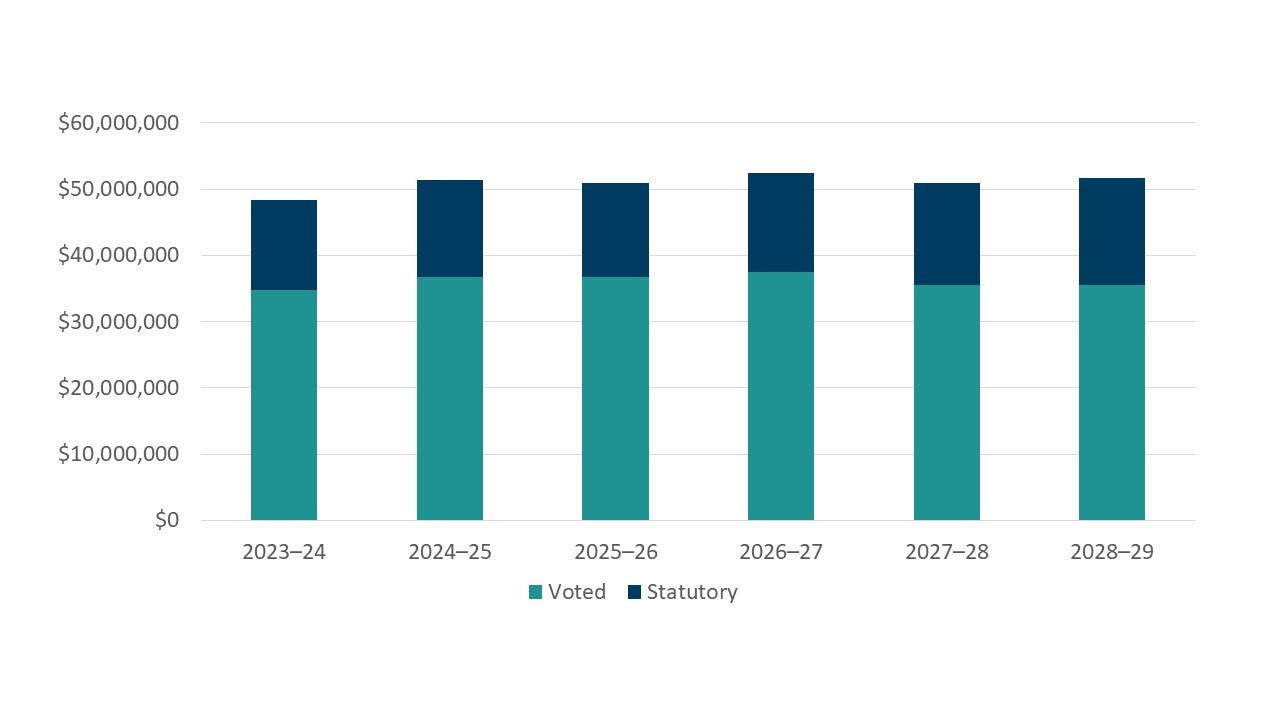
Text version of Graph [1]
| Fiscal year | Statutory | Voted | Total |
|---|---|---|---|
| 2023-24 | $13,579,263 | $34,782,562 | $48,361,825 |
| 2024-25 | $14,651,744 | $36,670,249 | $51,321,993 |
| 2025-26 | $14,169,939 | $36,665,903 | $50,835,842 |
| 2026-27 | $14,965,454 | $37,464,713 | $52,430,167 |
| 2027-28 | $15,314,196 | $35,562,355 | $50,876,551 |
| 2028-29 | $16,064,572 | $35,572,515 | $51,637,087 |
Analysis of statutory and voted funding over a six-year period
The increase noted in 2024–25 is largely due to funding received for collective agreement adjustments and general increases in statutory operating expenditures. The increase reflected in 2026-27 stems from funding reprofiled for the purpose of the West Memorial Building move.
Consult the Public Accounts of Canada for further information on the ORSCC’s departmental voted and statutory expenditures.
Financial statement highlights
This section presents the ORSCC’s Financial statements (Unaudited) for the year ended March 31, 2026.
Table [8]
Table [8] summarizes the expenses and revenues for 2025–26, which net to the cost of operations before government funding.
| Financial information | 2025–26 actual results | 2025–26 planned results | Difference (actual results minus planned) |
|---|---|---|---|
| Total expenses | $61,724,910 | $60,832,201 | $892,709 |
| Total revenues | $1,248 | $15,227 | $(13,979) |
| Net cost of operations before government funding | $61,723,662 | $60,816,974 | $906,688 |
Analysis of expenses and revenues for 2025–26
The increase noted in the 2025–26 actual results in comparison to planned results is mainly due to collective agreement adjustments and a general decrease in statutory operating expenditures.
The 2025–26 planned results information is provided in ORSCC’s Future-Oriented Statement of Operations and Notes 2025–26.
Table [9]
Table [9] summarizes actual expenses and revenues and shows the net cost of operations before government funding.
| Financial information | 2025–26 actual results | 2024–25 actual results | Difference (2025-26 minus 2024-25) |
|---|---|---|---|
| Total expenses | $61,724,910 | $62,088,587 | $(363,677) |
| Total revenues | $1,248 | $517 | $731 |
| Net cost of operations before government funding | $61,723,662 | $62,088,070 | $(364,408) |
Analysis of differences in expenses and revenues between 2024–25 and 2025–26
The decrease in actual results from 2024–25 to 2025–26 is mainly due to collective agreement adjustments and a general decrease in statutory operating expenditures.
Table [10]
Table [10] provides a brief snapshot of the amounts the department owes or must spend (liabilities) and its available resources (assets), which helps to indicate its ability to carry out programs and services.
| Financial information | Actual fiscal year (2025–26) |
Previous fiscal year (2024–25) |
Difference (2025–26 minus 2024–25) |
|---|---|---|---|
| Total net liabilities | $9,459,650 | $10,724,250 | $(1,264,600) |
| Total net financial assets | $7,897,813 | $8,242,325 | $(344,512) |
| Departmental net debt | $1,561,837 | $2,481,925 | $(920,088) |
| Total non-financial assets | $1,257,729 | $1,716,835 | $(459,106) |
| Departmental net financial position | $(304,108) | $(765,090) | $460,982 |
Analysis of department’s liabilities and assets since last fiscal year
The departmental net financial position has increased by $460,982 since the previous fiscal year, mostly due to a decrease in liabilities.
Human resources
This section presents an overview of the department’s actual and planned human resources from 2023–24 to 2028–29.
Table [11]
Table [11] shows a summary in full-time equivalents of human resources for the ORSCC’s core responsibility and for its internal services for the previous three fiscal years.
| Core responsibility and internal services | 2023–24 actual full-time equivalents | 2024–25 actual full-time equivalents | 2025–26 actual full-time equivalents |
|---|---|---|---|
| The administration of Canada’s final court of appeal | 150 | 150 | 154 |
| Internal services | 85 | 89 | 89 |
| Total | 235 | 239 | 243 |
Analysis of human resources for the last three years
The increase in full-time equivalents is mainly attributable to a reduction in vacancies and temporary salary pressures.
Table [12]
Table [12] shows the planned full-time equivalents for the ORSCC’s core responsibility and for its internal services for the next three years. Human resources for the current fiscal year are forecast based on year to date.
| Core responsibility and internal services | 2026–27 planned full-time equivalents | 2027–28 planned full-time equivalents | 2028–29 planned full-time equivalents |
|---|---|---|---|
| The administration of Canada’s final court of appeal | 159 | 159 | 159 |
| Internal services | 93 | 93 | 93 |
| Total | 252 | 252 | 252 |
Analysis of human resources for the next three years
No significant shift in full-time equivalents is anticipated.
Supplementary information tables
The following supplementary information tables are available on the ORSCC’s website:
Federal tax expenditures
The tax system can be used to achieve public policy objectives through the application of special measures such as low tax rates, exemptions, deductions, deferrals and credits. The Department of Finance Canada publishes cost estimates and projections for these measures each year in the Report on Federal Tax Expenditures. This report also provides detailed background information on tax expenditures, including descriptions, objectives, historical information and references to related federal spending programs as well as evaluations and GBA Plus of tax expenditures.
Corporate information
Departmental profile
Appropriate minister: The Honourable Sean Fraser, P.C, M.P.
Institutional head: Chantal Carbonneau
Ministerial portfolio: Justice
Enabling instruments:
Supreme Court Act (R.S.C., 1985, c. S-26)
Judges Act (R.S.C., 1985, c. J-1)
Year of incorporation or commencement: 1875
Departmental contact information
Mailing address
344 Wellington Street
Ottawa, Ontario
K1A 0J1
Telephone: 1-888-551-1185
Fax: (613) 996-3063
Email: reception@scc-csc.ca
Website: https://www.scc-csc.ca/
Chantal Carbonneau - Registrar
Telephone: (613) 947-8608
Email: reception@scc-csc.ca
Cristina Damiani - Deputy Registrar
Telephone: (613) 996-7521
Email: reception@scc-csc.ca
Emily Moreau - General Counsel & Director General, Legal Services Sector
Telephone: (613) 580-0346
Email: emily.moreau@scc-csc.ca
Catherine Laforce – Associate Deputy Minister, Corporate Services and Chief Financial Officer
Telephone: (613) 580-0323
Email: Catherine.Laforce@scc-csc.ca
Michel Gallant - Executive Director, Judicial Support and Protocol Services Sector
Telephone: (613) 996-4841
Email: Michel.Gallant@scc-csc.ca
- appropriation (crédit)
- Any authority of Parliament to pay money out of the Consolidated Revenue Fund.
- budgetary expenditures (dépenses budgétaires)
- Operating and capital expenditures; transfer payments to other levels of government, departments or individuals; and payments to Crown corporations.
- core responsibility (responsabilité essentielle)
- An enduring function or role of a department. The departmental results listed for a core responsibility reflect the outcomes that the department seeks to influence or achieve.
- Departmental Plan (plan ministériel)
- A report that outlines the anticipated activities and expected performance of an appropriated department over a three-year period. Departmental Plans are usually tabled in Parliament in spring.
- departmental priority (priorité)
- A plan, project or activity that a department focuses and reports on during a specific planning period. Priorities represent the most important things to be done or those to be addressed first to help achieve the desired departmental results.
- departmental result (résultat ministériel)
- A high-level outcome related to the core responsibilities of a department.
- departmental result indicator (indicateur de résultat ministériel)
- A quantitative or qualitative measure that assesses progress toward a departmental result.
- departmental results framework (cadre ministériel des résultats)
- A framework that connects the department’s core responsibilities to its departmental results and departmental result indicators.
- Departmental Results Report (rapport sur les résultats ministériels)
- A report outlining a department’s accomplishments against the plans, priorities and expected results set out in the corresponding Departmental Plan.
- Full-time equivalent (équivalent temps plein)
- Measures the person years in a departmental budget. An employee’s scheduled hours per week divided by the employer’s hours for a full-time workweek calculates a full-time equivalent. For example, an employee who works 20 hours in a 40-hour standard workweek represents a 0.5 full-time equivalent.
- Gender-based Analysis Plus (GBA Plus) (analyse comparative entre les sexes plus [ACS Plus])
- An analytical tool that helps to understand the ways diverse individuals experience policies, programs and other initiatives. Applying GBA Plus to policies, programs and other initiatives helps to identify the different needs of the people affected, the ways to be more responsive and inclusive, and the methods to anticipate and mitigate potential barriers to accessing or benefitting from the initiative. GBA Plus goes beyond biological (sex) and socio-cultural (gender) differences to consider other factors, such as age, disability, education, ethnicity, economic status, geography (including rurality), language, race, religion, and sexual orientation.
- government priorities (priorités pangouvernementales)
- For the purpose of the 2025–26 Departmental Results Report, government priorities are the high-level themes outlining the government’s agenda as announced in the 2025 Speech from the Throne.
- horizontal initiative (initiative horizontale)
- A program, project or other initiative where two or more federal departments receive funding to work collaboratively on a shared outcome usually linked to a government priority, and where the ministers involved agree to designate it as horizontal. Specific reporting requirements apply, including that the lead department must report on combined expenditures and results.
- Indigenous business (entreprise autochtones)
- Requirements for verifying Indigenous businesses for the purposes of the departmental result report are available through the Indigenous Services Canada Mandatory minimum 5% Indigenous procurement target website.
- non-budgetary expenditures (dépenses non budgétaires)
- Net outlays and receipts related to loans, investments and advances, which change the composition of the financial assets of the Government of Canada.
- performance (rendement)
- What a department did with its resources to achieve its results, how well those results compare to what the department intended to achieve, and how well lessons learned have been identified.
- performance indicator (indicateur de rendement)
- A qualitative or quantitative measure that assesses progress toward a departmental-level or program-level result, or the expected outputs or outcomes of a program, policy or initiative.
- plan (plan)
- The articulation of strategic choices, which provides information on how a department intends to achieve its priorities and associated results. Generally, a plan will explain the logic behind the strategies chosen and tend to focus on actions that lead to the expected result.
- planned spending (dépenses prévues)
- For Departmental Plans and Departmental Results Reports, planned spending refers to the amounts presented in Main Estimates. Departments must determine their planned spending and be able to defend the financial numbers presented in their Departmental Plans and Departmental Results Reports.
- program (programme)
- An Individual, group, or combination of services and activities managed together within a department and focused on a specific set of outputs, outcomes or service levels.
- program inventory (répertoire des programmes)
- A listing that identifies all the department’s programs and the resources that contribute to delivering on the department’s core responsibilities and achieving its results.
- result (résultat)
- An outcome or output related to the activities of a department, policy, program or initiative.
- statutory expenditures (dépenses législatives)
- Spending approved through legislation passed in Parliament, other than appropriation acts. The legislation sets out the purpose and the terms and conditions of the expenditures.
- target (cible)
- A quantitative or qualitative, measurable goal that a department, program or initiative plans to achieve within a specified time period.
- voted expenditures (dépenses votées)
- Spending approved annually through an appropriation act passed in Parliament. The vote also outlines the conditions that govern the spending.
Footnote
- Footnote 1
-
In 2023–24, the time lapse between the hearing of an appeal and the date when leave to appeal was granted or the notice of appeal as of right was filed increased to 45 weeks, largely due to the impact of the hearing of one appeal that, in an unusual set of judicial circumstances, was concluded three years after leave was granted.